Dwarf Galaxies Losing Most of Their Oxygen to Cosmic Winds
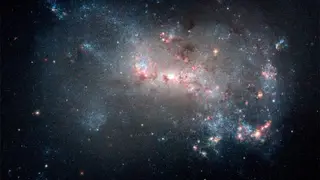
A study using Hubble data reveals that nearby dwarf galaxies retain only about 11% of the oxygen produced by their stars, with the rest likely expelled by supernova-driven winds. The research, part of the GLOW project, analyzed star formation histories and current gas content across 37 galaxies within 19.5 million light-years. Oxygen may now reside in intergalactic space or circumgalactic halos, suggesting active galactic feedback processes shape galaxy evolution.
A new study using data from the Hubble Space Telescope has revealed that nearby dwarf galaxies retain only about 11% of the oxygen produced by their stars, with the remainder likely expelled into intergalactic space via supernova-driven winds. The research, part of the Galaxies Losing Oxygen via Winds (GLOW) project, analyzed 37 dwarf galaxies within 19.5 million light-years of Earth—ranging in stellar mass from 3 million to 3 billion solar masses. By reconstructing each galaxy’s star formation history through Hubble observations of individual stars and measuring current oxygen content in gas, stars, and dust, scientists found that most oxygen resides in the interstellar medium rather than in stars or dust. The study’s findings confirm long-standing theories about galactic feedback, where energy from massive stars and supernovae drives outflows that eject metals like oxygen beyond a galaxy’s gravitational pull. Galaxies farther than 3.3 million light-years from larger neighbors consistently retained less than 15% of their oxygen, while those in denser environments showed greater variability, possibly due to gas recycling or accretion from neighboring systems. While earlier ultraviolet observations accounted for only 1–7% of produced oxygen, the team estimates circumgalactic halos may hold an additional 5–35%, suggesting much of the missing oxygen remains in the surrounding space but beyond immediate detection.
The GLOW project is led by Dr. Kristen Wingfield McQuinn at the
This discovery could reshape how astronomers model galaxy formation, particularly for low-mass systems that are thought to be building blocks of larger galaxies. By showing that dwarf galaxies lose most of their oxygen, it underscores the importance of feedback mechanisms in shaping galactic evolution—potentially affecting predictions about star formation rates and chemical enrichment over cosmic time. Institutions involved in space-based astronomy, such as NASA and ESA, may prioritize missions with enhanced sensitivity to diffuse intergalactic gas, including future instruments like the Roman Space Telescope. The findings also challenge existing cosmological simulations, which may need recalibration to account for stronger outflows in smaller galaxies. A comparable case is the discovery of missing baryons in the early universe, where a significant portion of normal matter was found not in galaxies but in hot, diffuse filaments—this study similarly suggests that key elements like oxygen