Ancient Kidney Stone Discovered in 5,300-Year-Old Burial Site
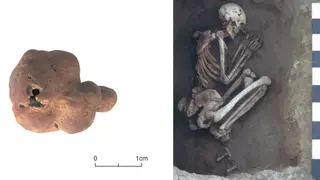
A 5,300-year-old kidney stone, roughly the size of a grape, was discovered within the remains of a Bronze Age cattle herder buried near the Black Sea. The find offers rare insight into ancient human health and disease from prehistoric times.
A kidney stone, approximately the size of a grape, was discovered within the skeletal remains of a Bronze Age individual buried near the Black Sea, dating back about 5,300 years. The individual is believed to have been a cattle herder, offering a rare glimpse into the health conditions of prehistoric pastoral communities. This discovery marks one of the oldest known instances of kidney stones in human remains, providing direct evidence of metabolic or dietary conditions that may have affected ancient populations. The site’s location near the Black Sea adds geographical context to understanding mobility, diet, and environmental exposure during the early Bronze Age.
While no specific names of researchers or institutions are mentioned, such findings typically emerge from archaeological teams conducting excavations in regions with well-preserved organic remains. These studies often build on prior work identifying disease markers in ancient bones, such as evidence of arthritis or dental issues. The significance lies in the rarity of soft tissue pathology surviving for millennia, making this find particularly valuable for reconstructing health patterns across time. The absence of further details about the research team or institution means their identities and objectives remain unknown.
The broader implications of such discoveries may influence how we interpret ancient lifestyles and environmental pressures. However, no information is available regarding future studies, funding p
This discovery could deepen public awareness of ancient human health, challenging the perception that modern lifestyles are uniquely responsible for conditions like kidney stones. It may prompt renewed interest in paleopathology and encourage interdisciplinary collaboration between archaeologists, medical historians, and geneticists. Institutions focused on heritage preservation or museum curation might use the find to develop exhibits highlighting the continuity of certain health issues across millennia. A comparable case is the discovery of tuberculosis in 5,000-year-old Egyptian mummies, which reshaped understanding of ancient infectious disease. Like that finding, this kidney stone may prompt re-evaluation of other skeletal remains for similar markers. However, unlike those cases, this one lacks details on methodology or broader context, so its impact remains speculative. What to watch for includes whether further analysis will be published, if the specimen is archived in a publi