Ancient Roman Personal Artifacts Unearthed in Sealed Wardrobe at Pompeii
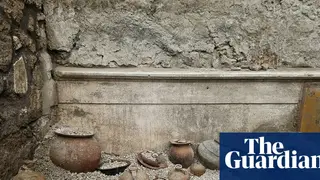
Archaeologists have discovered a collection of personal items—including a perfume bottle, coins, cooking tools, and a child’s necklace—inside a wooden wardrobe preserved since the eruption of Mount Vesuvius in AD79. The find offers rare insight into domestic life and social customs in ancient Pompeii.
In October 2026, archaeologists working at Pompeii uncovered a wooden wardrobe sealed since the catastrophic eruption of Mount Vesuvius in AD79, revealing a trove of personal artifacts within a residence on Via dell’Abbondanza—the city’s most active commercial street. Among the finds were a glass perfume bottle, tweezers, an incense burner, a bronze lantern, 38 bronze coins, cooking pots, a wooden box with lead weights, and a child’s necklace known as a crepundia, adorned with over 20 charms depicting deities such as Bes and Mercury. The presence of the necklace, traditionally worn by children to aid identification and provide comfort, suggests emotional ties and mobility within Roman society. The home, previously linked to an individual named Cornelius Maximus through now-invisible inscriptions, was first excavated in 1912 but has only recently been revisited as part of a broader restoration initiative. The discovery of fragmented mouse skeletons inside a storage amphora adds a layer of domestic detail, possibly indicating food storage or pest activity. The fact that personal items and coins were left behind implies a sudden evacuation, offering rare evidence of the panic that may have accompanied the eruption.
Gabriel Zuchtriegel, director of the Pompeii Archaeological Park, emphasized the significance of studying servant quarters rather than elite residences, noting that such spaces provide insight into the overlooked daily lives and economic roles of non-elite inhabitant
The discovery could deepen public engagement with ancient Roman life by humanizing historical narratives through everyday objects, particularly those tied to children and domestic routines. The crepundia necklace, in particular, may resonate emotionally with modern audiences, drawing attention to themes of family, displacement, and memory—issues still relevant today. Museums and educational institutions may leverage such finds to develop interactive exhibits that emphasize personal stories over grand monuments, potentially broadening access to classical history beyond elite narratives. The focus on servant quarters also aligns with broader academic trends in archaeology toward social and economic inclusivity, challenging long-standing biases that prioritize aristocratic sites. Comparable to the 19th-century rediscovery of Herculaneum’s library, this find may prompt renewed interest in lesser-known urban layers of Roman life. It could influence how future excavations are prioritized—sh