Markets Mixed Ahead of Midterm Elections Amid Volatility and Sector Shifts
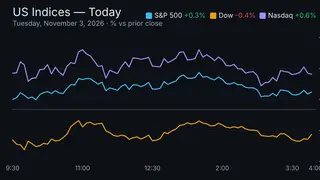
Markets ended Tuesday with mixed results as investors weighed election-day sentiment against rising political uncertainty, with the Nasdaq leading gains despite a decline in the Dow Jones. Tech stocks rebounded strongly, particularly AI-related firms like Nvidia, while concerns over inflation data pressured bond yields and rate-sensitive blue chips. Commodity prices were volatile, with WTI crude edging up on Middle East supply fears and gold slipping as Treasury yields rose.
On Tuesday, November 3, 2026, U.S. stock markets closed with mixed results amid heightened anticipation surrounding the midterm elections. The Nasdaq Composite rose 0.83% to 25,372.01, driven by a strong rebound in technology stocks—particularly AI-focused firms like Nvidia, which surged 2.8%. In contrast, the Dow Jones Industrial Average declined 0.38% to 51,786.72, pressured by a surprisingly strong JOLTS report that pushed the 10-year Treasury yield to 4.93%, weighing on rate-sensitive blue chips. The S&P 500 gained 0.36% to 7,568.92, while the Russell 2000 edged up 0.23%. Commodity markets showed volatility: WTI crude rose 0.36% to $96.81 per barrel amid supply concerns following U.S. military strikes on Iran’s Qeshm Island, while gold fell 0.90% to $3,933.80 as bond yields climbed. Sector performance diverged sharply—semiconductors jumped 4.28%, supported by new Department of Energy funding for power grid supply chains and surging data center demand—while Air Transportation dropped 2.98% due to bomb threats targeting European flights, and Retail-Grocery Stores fell 2.84% after a cyberattack disrupted refrigeration systems across Europe.
The broader market context reflects growing political uncertainty ahead of the midterms, with investors balancing historical post-election optimism against near-term risks. The surge in tech stocks, especially AI-related names, signals continued investor confidence in innovation-driven growth despite macroeconomic headwinds. Meanwhile, r
The mixed market performance on election eve underscores how financial markets react not just to policy outcomes but to perceived stability and risk. Tech-led gains may reflect investor confidence in long-term innovation, particularly in AI and infrastructure, even as inflation pressures persist. However, the sharp decline in sectors like homebuilding and consumer staples—already sensitive to interest rates—could signal broader economic fragility if rate hikes continue. The cyberattack on European grocery systems and security threats to air travel highlight how non-economic events can disrupt markets, especially in interconnected global supply chains. Comparable to the 2016 election cycle, when uncertainty initially drove volatility before stabilizing post-vote, this moment may see a similar pattern—though with heightened sensitivity due to inflation and geopolitical tensions. What remains unclear is whether the current rally in tech stocks will persist beyond election day or if a shif