Dwarf Galaxies Are Losing Most of Their Oxygen Over Time, Challenging Cosmic Evolution Models
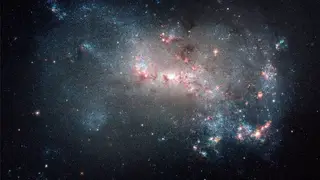
A new study analyzing 37 nearby dwarf galaxies reveals they retain only about 15% of the oxygen produced by their stars, with the rest likely expelled by galactic winds. This unexpected finding suggests significant gaps in our understanding of how elements are distributed and retained in small galaxies over cosmic time. The research, based on data from Hubble and other observatories, highlights the role of supernovae in oxygen production and loss.
A new study led by Grace Telford of the University of Utah and published in The Astrophysical Journal reveals that nearby dwarf galaxies retain only about 15% of the oxygen produced by their stars, with the remainder likely expelled into the circumgalactic medium (CGM) or intergalactic space. Analyzing data from the Hubble Space Telescope, Spitzer Space Telescope, and ground-based observatories like the Very Large Array and Australian Telescope Compact Array, researchers examined 37 low-mass dwarf galaxies—each containing between a few thousand and hundreds of millions of stars. These galaxies are found in the local universe, with observations conducted through the Galaxies Losing Oxygen via Winds (GLOW) project, jointly funded by NASA and the National Science Foundation. The findings challenge existing models of galactic chemical evolution, as current simulations underestimate how much oxygen these small systems lose over time. Core-collapse supernovae from massive stars are identified as the primary source of oxygen, though minor contributions come from other stellar remnants. The study shows that in dwarf galaxies, oxygen abundance is roughly one atom per 10,000–20,000 hydrogen atoms—significantly lower than the Milky Way’s ratio of one per 2,000. This suggests that galactic winds driven by supernovae and massive star radiation are far more effective at expelling heavy elements from low-mass systems than previously thought. The missing oxygen is likely dispersed in gaseous halos surrounding galaxies or even beyond into intergalactic space. What remains unresolved is whether current galaxy formation simulations can be adjusted to account for these losses, or if new physics—such as feedback mechanisms or dark matter interactions—must be introduced.
This discovery could reshape how scientists model the distribution of life-supporting elements across the cosmos, with implications for astrobiology and planetary science. If dwarf galaxies—common in the early universe—are inefficient at retaining oxygen and other heavy elements, it may mean that planet formation and habitability were less widespread than earlier models suggested, particularly in the first few billion years of cosmic history. The findings may also influence how astronomers interpret data from upcoming missions like the James Webb Space Telescope, which will probe early galaxy formation with greater precision. Institutions developing cosmological simulations—such as those at NASA, ESA, and academic centers worldwide—may need to revise their feedback algorithms to better reflect the role of stellar winds in element ejection. A comparable earlier case is the discovery of dark matter’s influence on galactic rotation curves in the 1970s, which forced a fundamental rethinking of gravity and galaxy structure. Similarly, this oxygen deficit may prompt a paradigm shift in how we understand baryonic feedback in low-mass systems. What to watch for next includes updated simulations incorporating stronger wind feedback, as well as observational campaigns targeting CGM gas in other dwarf galaxies. The outcome could affect not only astrophysics but also public understanding of our cosmic origins—potentially altering narratives about the prevalence of life-supporting conditions in the universe.