New study reveals T. rex hatchlings were kitten-sized and likely independent
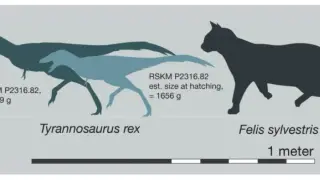
A study from the University of Saskatchewan indicates that T. rex hatchlings were roughly the size of kittens at birth, based on fossil analysis of juvenile bones. These small dinosaurs were likely left to fend for themselves after hatching, with only the most resilient surviving. The research, published in the journal Biology in July 2026, suggests that T. rex parents provided little to no parental care.
A new study published in the journal Biology on July 7, 2026, reveals that Tyrannosaurus rex hatchlings were roughly the size of modern kittens, based on detailed fossil analysis conducted by researchers at the University of Saskatchewan. Using the Canadian Light Source synchrotron, scientists examined juvenile T. rex bones, including metatarsals, to analyze growth patterns, bone density, and internal structures like blood vessels. These findings confirmed the specimens were indeed from hatchlings, not embryos, and allowed researchers to estimate their size at birth. The study, led by Nick Longrich of the University of Bath and supported by the University of Saskatchewan, suggests that T. rex mothers laid between 30 and 100 eggs per clutch, a reproductive strategy consistent with r-selection—where high offspring numbers compensate for low survival rates. This implies minimal parental care, with hatchlings left to fend for themselves, making them vulnerable to predators. Longrich noted that while some parental involvement likely occurred—more than in crocodiles or turtles, less than in birds—it was not the intensive care seen in modern avian species. The lack of fossil evidence for nests or juvenile remains further supports the idea that most hatchlings did not survive infancy.
The research builds on earlier paleontological work that has long speculated about dinosaur parenting behaviors, but this is the first to use synchrotron imaging to directly analyze juvenile bone microstructure. The findings contribute to broader discussions about the evolution of reproductive strategies in dinosaurs, particularly the transition from reptilian to avian-like parenting. While the study offers strong evidence for minimal parental investment, it does not rule out rare instances of care. What remains unknown is whether any T. rex individuals exhibited more complex social behaviors, such as group rearing or protection of vulnerable young. Future research may focus on discovering more juvenile fossils or analyzing nesting sites, which could provide further insight into early life stages and survival strategies.
This study could influence public understanding of T. rex, shifting perceptions from a fearsome parent to a species with a high-risk, high-reward reproductive strategy. The image of a kitten-sized T. rex may spark renewed interest in paleontology among younger audiences, potentially boosting science education and museum attendance. Educational platforms like EarthSky, which disseminated the findings, may see increased engagement, especially through multimedia content such as videos and interactive timelines. The broader impact may extend to how science communication frames evolutionary trade-offs—highlighting that even apex predators faced intense selection pressures early in life. A comparable case is the 2014 discovery of dinosaur embryos with evidence of brooding behavior in oviraptorids, which similarly challenged assumptions about dinosaur parenting. However, unlike that case, this study emphasizes abandonment rather than care, suggesting a different evolutionary path. What may follow is increased funding for synchrotron-based paleontological research, as well as renewed efforts to locate fossilized nests or juvenile remains. The scientific community may also begin re-evaluating other large dinosaurs with similar clutch sizes, potentially reshaping our understanding of dinosaur social evolution.