U.S. Stock Markets Surge on Risk-On Rally Amid Geopolitical Relief and Fed Rate Hopes
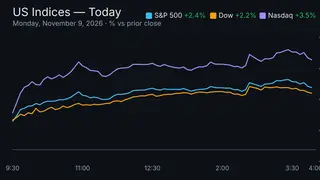
U.S. equity markets rebounded strongly on Monday, November 9, 2026, with the Nasdaq entering positive territory after a sharp rally fueled by aggressive buying during market dips. The S&P 500 rose 2.35%, the Dow Jones gained 2.15%, and the Russell 2000 led all major indices with a 3.15% surge, while the VIX dropped 22.35% as investor fear subsided. Gold climbed 1.79% to $4,147.80 on expectations of a less aggressive Federal Reserve, while oil prices fell 4.21% after President Trump downplayed imminent military action against Iran.
On Monday, November 9, 2026, U.S. stock markets staged a sharp recovery, with the S&P 500 rising 2.35% to close at 7,549.94, the Dow Jones gaining 2.15% to 52,389.75, and the Nasdaq surging 2.74% to 25,253.14—officially exiting correction territory. The Russell 2000 led all major indices with a 3.15% jump, while the VIX fear index dropped 22.35% to 19.91, signaling a significant retreat in market anxiety. This rally was driven by aggressive dip buying following the S&P 500’s worst weekly performance since June. Key catalysts included President Trump’s public dismissal of imminent military action against Iran, which caused WTI crude oil to fall 4.21% to $87.01 and reduced geopolitical risk premiums. Gold rose 1.79% to $4,147.80 as falling energy prices cooled inflation expectations, reinforcing speculation that the Federal Reserve may adopt a less aggressive stance on interest rates. Sector performance was uneven: Aerospace & Defense surged on strength in SpaceX (+5.8%) and Tesla (+5.5%), while Metals & Mining gained on gold demand. Notably, Nvidia (NVDA) declined 4.3% due to an independent board probe into CEO Jensen Huang’s ties with a suspected foreign agent—a rare outlier in the broader market rebound.
The broader context reflects a market recalibrating after weeks of volatility driven by geopolitical tensions and inflation concerns. The recent dip in oil prices, coupled with political reassurance from President Trump, removed a key source of uncertainty that had previously pressured energy stocks and fueled inflation fears. Investors appear to be pivoting toward risk-on strategies, particularly in high-growth sectors like AI, quantum computing, and space technology, which saw strong gains. The rally was also supported by positive sentiment around upcoming economic data, including the October CPI report due November 10, which may influence Fed policy expectations. However, unresolved issues remain: the independent investigation into Nvidia’s CEO could escalate, potentially affecting investor confidence in tech leadership. Additionally, while short squeeze candidates like BOBS and KPLT show strong readiness and high short floats, their volatility remains a risk. The market’s next move likely hinges on inflation data and whether the Fed signals a pause or reversal in rate hikes.
The broad-based rally may temporarily ease financial stress for investors and consumers who had been bracing for continued volatility, particularly in energy-dependent sectors. A drop in oil prices could lower transportation and manufacturing costs, potentially easing inflationary pressures across the economy—though this effect may be short-lived if geopolitical tensions resurge. The surge in aerospace and defense stocks reflects renewed confidence in U.S. technological leadership, which could bolster long-term investment in national security infrastructure. However, such gains may also fuel concerns about military spending priorities versus domestic needs like healthcare or climate resilience. The strong performance of gold and metals suggests that investors are still hedging against macroeconomic uncertainty, even amid risk-on sentiment—indicating a cautious optimism rather than full confidence. A comparable earlier case is the 2018 market rebound after U.S.-North Korea tensions eased, which similarly triggered a broad rally in defense and commodity stocks. What may follow is a period of heightened sensitivity to economic data, particularly the upcoming CPI and PPI reports, which could either sustain or reverse the current momentum. Investors should watch for whether the Fed’s tone shifts toward dovishness, as that could determine if this rally becomes sustained or merely a temporary reprieve.