Fossil Teeth from Thailand Uncover 35-Million-Year-Old Rodent the Size of a Large Dog
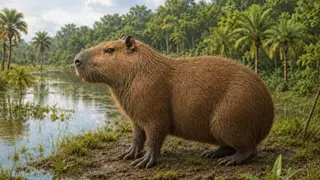
Paleontologists have identified a new species of ancient rodent, Yakamys sirindhornae, from just two fossil teeth found in southern Thailand’s Krabi province. Estimated to weigh around 30 kilograms—comparable to a large dog—the animal lived during the Late Eocene, about 35 million years ago, and represents one of the earliest known examples of large-bodied rodents outside South America. The discovery suggests that giant rodent evolution began earlier and in more diverse regions than previously thought, with its tooth structure indicating it belonged to the Ischyromyidae family.
Paleontologists have identified a new species of ancient rodent, Yakamys sirindhornae, from just two fossil teeth discovered in a coal seam at the Krabi lignite mine in southern Thailand’s Krabi province. Dating to the Late Eocene, approximately 35 million years ago, the animal is estimated to have weighed around 30 kilograms—comparable to a large dog—making it one of the earliest known examples of a large-bodied rodent outside South America. The fossils consist of a single lower molar measuring 11.6 mm long and 11.3 mm wide, significantly larger than those of previously known Asian relatives, which had molars less than half that size. The species belongs to the Ischyromyidae family, based on tooth morphology and microscopic enamel structure, despite its incisor enamel being remarkably thin at about 235 micrometers. This discovery challenges prior assumptions that giant rodent evolution was primarily a South American phenomenon, suggesting instead that large body size evolved earlier and in more geographically diverse regions than previously recognized. The findings are detailed in a 2026 study published in Scientific Reports by Yaowalak Chaimanee and colleagues from McGill University, with Professor Virginie Millien as a co-author.
The research builds on earlier work identifying large rodents such as Manitsha tanka from South Dakota’s Oligocene epoch, which also exhibited substantial body size but differed markedly in molar shape and size from Yakamys sirindhornae. This divergence implies that gigantism in ischyromyids may have evolved independently or through multiple pathways. While the fossil record remains sparse—limited to two teeth—the study highlights Southeast Asia’s potential role in early rodent evolution, a region previously underrepresented in discussions of large-bodied mammal development. The team acknowledges that body mass estimates are approximate due to limited material, and further discoveries are needed to clarify Yakamys sirindhornae’s ecology, evolutionary trajectory, and relationships within the Ischyromyidae family. What remains unknown is whether similar large rodents existed elsewhere in Asia during this period or if this species was an isolated evolutionary experiment.
This discovery could reshape how scientists view the geographic and temporal spread of rodent gigantism, potentially prompting renewed exploration in under-sampled regions like Southeast Asia. While capybaras remain the largest living rodents, the existence of a 30-kilogram rodent 35 million years ago suggests that body size evolution in this group may have been more dynamic and widespread than previously believed. This could influence paleontological research priorities, encouraging institutions such as McGill University and Thai geological surveys to invest in fieldwork in similar sedimentary basins across Asia. The finding may also impact public understanding of evolutionary patterns, challenging the common perception that giant mammals were confined to later epochs or specific continents. A comparable precedent is the 2010 discovery of Josephoartigasia monesi in South America, which redefined expectations about rodent size and sparked renewed interest in fossil rodents across the Americas. Similarly, Yakamys sirindhornae may inspire broader reassessments of early mammalian evolution in Asia. If future finds confirm a pattern of early gigantism in multiple regions, it could suggest that ecological or climatic factors during the Eocene—such as warm climates and abundant vegetation—favored large body size more broadly. Researchers may now look for similar fossils in other coal-bearing deposits across Southeast Asia, while museums and educational platforms could use this story to illustrate how limited evidence can still yield transformative insights. The next critical step will be uncovering more complete remains, which could reveal whether these early giants shared ecological niches with other large mammals of the time.