New Tapejarid Pterosaur Species Discovered in British Fossil Collection
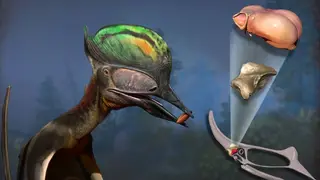
Paleontologists have identified a new pterosaur species, Hintighernia edingerae, from a fossil specimen originally described in 1870 and housed in the Sedgwick Museum of Earth Sciences in Cambridge, England. The creature lived during the Cretaceous period, about 105 to 100 million years ago, and represents the first confirmed tapejarid pterosaur found outside South America. Its skull features a short, downturned snout and suggests that tapejarids may have had deeper European origins than previously believed.
Paleontologists have identified a new pterosaur species, Hintighernia edingerae, from a fossil originally described in 1870 and housed in the Sedgwick Museum of Earth Sciences in Cambridge, England. The specimen dates to the Cretaceous period, approximately 105 to 100 million years ago, and comes from the Cambridge Greensand Member of the West Melbury Marly Chalk Formation—a sediment layer that has yielded over 2,000 pterosaur specimens. This discovery marks the first confirmed tapejarid pterosaur found outside South America, challenging long-held assumptions about the group’s geographic origins. The fossil’s short, downturned snout and skull features align with those of other tapejarids, particularly Tapejara wellnhoferi, while micro-CT scans revealed a braincase endocast similar to that species, suggesting close evolutionary ties. Researchers also identified additional bone fragments—possibly from the same genus—and attributed other remains to broader tapejarid and azhdarchoid groups, indicating at least three distinct azhdarchoid species in the region.
The identification builds on earlier hints of tapejarid presence beyond South America, such as a 1999 discovery in Morocco’s Kem Kem Group and later finds in North Africa in 2020. However, this British specimen is the first to be formally described as a new genus and species based on comprehensive analysis. The team, led by Rubi Pêgas of Universidade Federal do ABC, argues that Ornithostoma sedgwicki—previously assigned to this fossil—should now be restricted to a different pterosaur, specifically a chaoyangopterid. This reclassification reflects evolving understanding of pterosaur taxonomy and neuroanatomy. The findings suggest Europe may have been a key center for early tapejarid diversification, potentially serving as a source for later lineages in eastern Asia and South America via dispersal routes possibly linked to the Eurogondwana hypothesis. What remains unresolved is whether these European tapejarids represent an ancestral population or a later migration; further phylogenetic studies are needed to clarify evolutionary relationships.
The discovery of Hintighernia edingerae could reshape public and scientific understanding of pterosaur biogeography, shifting focus from South America as the epicenter of tapejarid evolution to Europe as a potential cradle. This may influence how museums present prehistoric life, with institutions like the Sedgwick Museum likely updating exhibits to reflect this new narrative. For paleontological research, it underscores the value of re-examining historical collections using modern techniques like micro-CT scanning—highlighting that decades-old specimens can still yield groundbreaking insights. Comparable in impact to the 2014 reclassification of Archaeopteryx remains, which reshaped bird evolution debates, this finding may prompt renewed scrutiny of other “classic” fossils in European and global collections. Institutions and funding bodies may respond by prioritizing digital curation and reanalysis of museum holdings, especially those from understudied geological formations. The broader scientific community may also reconsider assumptions about Cretaceous dispersal patterns, particularly across the Tethys Sea and via North Africa. While no immediate commercial or policy implications arise, the story could inspire educational outreach and public interest in paleontology, especially among younger audiences drawn to dramatic prehistoric creatures. What to watch for next is whether similar reanalyses uncover other unexpected pterosaur diversity in old collections—potentially revealing more hidden evolutionary chapters in Earth’s history.