Stock Markets Decline Amid Inflation Concerns and Fed Hawkish Signals
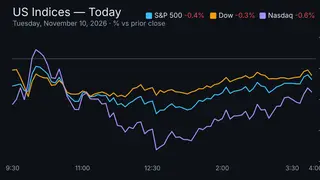
Wall Street closed lower on Tuesday as stronger-than-expected October inflation data fueled expectations of a December Federal Reserve rate hike. The Nasdaq led losses with a 0.74% drop, while defensive sectors like cable television and insurance outperformed amid a rotation away from high-beta tech stocks. Gold fell 1.84%, and real estate-related stocks declined as rising Treasury yields and a stronger US dollar pressured non-cyclical assets.
On Tuesday, November 10, 2026, U.S. stock markets closed lower amid renewed inflation concerns following stronger-than-expected October Consumer Price Index (CPI) data, which showed headline inflation rising 0.4% and core inflation up 0.3%. This fueled speculation that the Federal Reserve may raise interest rates in December, prompting a shift in investor sentiment. The Nasdaq Composite led losses with a 0.74% decline to close at 25,065.88, while the S&P 500 dipped 0.38% and the Dow Jones Industrial Average fell 0.30%. Despite broader market declines, volatility eased slightly as the CBOE Volatility Index (VIX) dropped 2.41% to 19.44. Defensive sectors such as cable television services (+4.91%) and accident & health insurance (+2.40%) outperformed, reflecting a rotation away from high-beta tech stocks. Meanwhile, gold fell 1.84% to $4,038.70, and real estate-related stocks declined sharply, with Real Estate Agents & Managers dropping 4.29%. Rising Treasury yields and a stronger U.S. dollar pressured non-cyclical assets, contributing to losses in mining and energy stocks despite crude oil’s modest gain. Key upcoming events include the FOMC meeting minutes on November 18 and Nvidia’s Q3 earnings report on November 17.
The Federal Reserve’s hawkish signals from officials Waller and Logan amplified market anxiety, reinforcing expectations of continued rate hikes to combat persistent inflation. This shift comes after months of mixed economic data and prior Fed guidance suggesting a pause in tightening. Investors are now weighing the risk of prolonged high rates against potential economic slowdowns. The rotation into defensive sectors suggests growing caution, particularly as tech stocks—long seen as growth engines—face pressure from higher discount rates. Meanwhile, short squeeze candidates like ZBIO and CYRX show signs of strong momentum, indicating speculative interest in volatile names. However, the broader market remains sensitive to macroeconomic data, especially jobless claims and producer price index reports due in the coming week. What remains uncertain is whether inflation will sustain its upward trajectory or if the Fed will delay a December hike despite recent data.
The market reaction underscores how inflation data continues to shape investor behavior, particularly around interest rate expectations. A sustained rise in Treasury yields and a stronger dollar may pressure not only equities but also bond markets and global capital flows, potentially affecting emerging markets more acutely. The outperformance of defensive sectors like cable TV and insurance suggests investors are prioritizing stability over growth, which could dampen innovation-driven sectors such as tech and biotech in the near term. This shift mirrors the 2022–2023 period when rising rates led to a broad rotation from growth to value stocks, though today’s environment features more pronounced volatility in speculative segments like crypto and small-cap stocks. The strong performance of reinsurance and edge computing infrastructure hints at resilience in niche areas, but broader economic uncertainty remains. What may follow is increased scrutiny on corporate earnings, particularly for high-momentum firms like Nvidia, whose upcoming report could signal whether tech’s rebound is sustainable. Investors should monitor the FOMC minutes for clues on future policy direction, as well as jobless claims and PPI data, which could either confirm or challenge current inflation narratives.