Africa’s Solar Capacity to Surge Sixfold by 2035 as Investment Hits $110 Billion
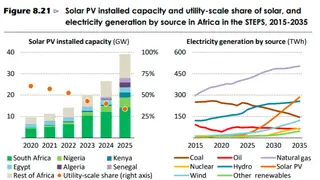
Africa’s solar photovoltaic capacity is projected to increase sixfold by 2035, reaching about 234 gigawatts, according to the IEA’s World Energy Outlook 2026. Annual energy investment in the region is expected to reach $110 billion in 2026, despite Africa holding 60% of the world’s best solar resources and only 1% of global solar capacity. Expanding electricity demand and limited grid infrastructure remain key challenges to scaling solar deployment.
Africa’s solar photovoltaic (PV) capacity is projected to grow from 39 gigawatts (GW) in 2025 to approximately 234 GW by 2035, a sixfold increase under the IEA’s Stated Policies Scenario, according to the World Energy Outlook 2026. This surge coincides with annual energy investment reaching $110 billion in 2026, despite Africa holding 60% of the world’s best solar resources and only 1% of global solar capacity. The continent’s electricity demand is expected to rise by 50% between 2025 and 2035, driven by household electrification, industrial growth, digital infrastructure, and cooling needs, with desalination emerging as a major new demand source in North Africa. While solar PV is set to account for nearly 40% of installed generation capacity by 2035, its actual contribution to electricity generation will remain below 20%, constrained by grid limitations and intermittency. Small-scale solar installations, particularly in Algeria, Kenya, Nigeria, and Senegal, became the largest source of new capacity in 2025, with South Africa accounting for over one-third of solar PV imports from China—up 28-fold since 2017. These systems are increasingly replacing diesel generators, with solar home systems offering electricity at about 50% lower cost. However, many existing systems remain underpowered, serving only basic lighting and phone charging. The IEA notes that most new solar capacity will serve existing consumers rather than expand access to the 570 million people still without electricity, highlighting a gap between infrastructure growth and equitable access.
The projected solar expansion could significantly alter Africa’s energy landscape, potentially reducing reliance on diesel generators and lowering emissions, particularly in off-grid and peri-urban areas. With solar home systems now more cost-competitive than small generators, widespread adoption may accelerate energy access, especially in rural communities where grid extension is economically unfeasible. However, the continued dominance of fossil fuel investment—particularly in oil and gas infrastructure in Mozambique, Namibia, Senegal, and Uganda—suggests that the energy transition remains uneven. The success of this shift may depend on overcoming high financing costs and inadequate grid infrastructure, which could limit the full potential of distributed solar. A comparable case is India’s solar revolution, where policy support and declining costs drove rapid deployment despite initial grid constraints. What remains uncertain is whether investment will shift sufficiently from export-oriented fossil fuel projects to domestic renewable infrastructure and storage. The next key indicator will be whether the projected 40 million people gaining electricity access annually by 2030 can be sustained through targeted investment in mini-grids and standalone systems, especially in underserved regions.