Using Solar Array Shadows and Power Data to Navigate Lunar Orbit Without Ground Tracking
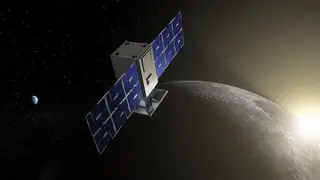
Engineers from Advanced Space, Space Exploration Engineering, and Texas A&M have proposed a novel method for tracking spacecraft in lunar orbit by analyzing changes in solar array power output during eclipses. As a spacecraft moves through the Moon's umbra and penumbra shadows, the drop in solar radiation alters power generation, providing precise timing data that can be used to determine position without relying on NASA’s Deep Space Network. This low-cost technique leverages existing onboard systems and could help manage growing satellite tracking demands.
In January 2026, NASA’s CAPSTONE CubeSat, operated by Advanced Space, passed through the Moon’s shadow during a lunar eclipse, providing critical data for a novel navigation method. During this event, the spacecraft’s solar array voltage dropped from 23V to near zero and then recovered to 31V, with precise timestamps recorded in its telemetry. Engineers Ian Down (Advanced Space), James McElreath (Space Exploration Engineering), and Manoranjan Majji (Texas A&M) used this real-world data to test an algorithm that calculates a spacecraft’s position by analyzing the timing of solar power loss and recovery during eclipses. Their method, detailed in a pre-print paper on arXiv, achieved positional accuracy within 15 seconds of CAPSTONE’s actual trajectory and reduced position uncertainty by over 60% when ground tracking was unavailable—demonstrating its potential as a low-cost backup system. The technique relies on known shadow geometries from the Sun, Earth, and Moon, with historical data from 22,000 observations (1842–2011) helping refine Earth’s atmospheric shadow effects. This innovation emerged in response to growing strain on NASA’s Deep Space Network (DSN), which is increasingly overwhelmed by the rising number of deep-space missions. While not replacing traditional radio tracking, it offers a zero-SWaP (zero Size, Weight, and Power) solution that uses existing onboard systems—specifically solar array monitoring already required for power management.
The researchers’ work builds on prior knowledge of celestial mechanics and eclipse patterns, particularly the complex shapes of lunar shadows influenced by surface topography. The Moon’s jagged terrain causes variations in shadow timing, while Earth’s atmosphere blurs its shadow, complicating predictions. By cross-referencing historical eclipse data with ground features, the algorithm can infer a spacecraft’s location over specific regions. This approach could become vital as cislunar traffic increases, especially with future missions like the Lunar Gateway and commercial ventures. However, it remains untested in real-time navigation scenarios or under conditions of extended communication loss. The long-term viability and integration into operational mission protocols are still unknown, as is whether this method can be scaled across diverse spacecraft designs.
This innovation could significantly ease pressure on centralized tracking infrastructure like NASA’s Deep Space Network, which faces growing demand from both government and private space missions. As more satellites enter lunar orbit—including CubeSats, science platforms, and commercial assets—reliance on a limited number of ground stations risks creating bottlenecks. A low-cost, onboard navigation method that requires no additional hardware may help prevent tracking failures during critical mission phases. The approach could particularly benefit small spacecraft with constrained resources, enabling them to maintain autonomy during eclipse periods when traditional systems are compromised. Comparable in spirit to early GPS self-navigation, this technique may become a standard feature in future deep-space missions, reducing dependency on ground control. However, it is not a full replacement for radio tracking and would likely be used as a complementary safety net. What remains to be seen is how quickly space agencies and private operators will adopt such passive, data-driven methods—and whether regulatory or mission design standards will evolve to incorporate eclipse-based navigation as a formal requirement.