New Simulations Suggest Little Red Dots Are Remnants of Primordial Supermassive Stars
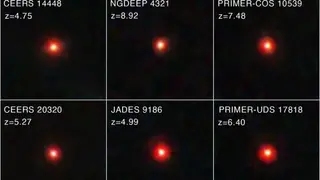
Computer simulations led by Dr. Daniel Whalen from the University of Portsmouth suggest that the mysterious 'Little Red Dots' observed by the James Webb Space Telescope are not early quasars or black hole seeds, but rather remnants of collapsed supermassive primordial stars surrounded by dense gas envelopes. These galaxies appeared around 600 million years after the Big Bang and declined rapidly by 1.5 billion years post-Big Bang, indicating a short-lived evolutionary phase before becoming luminous quasars. The findings, published in The Astrophysical Journal Letters, involve researchers from the United Arab Emirates University, Aristotle University of Thessaloniki, the University of Edinburgh, and the Harvard & Smithsonian Center for Astrophysics.
In 2026, observations from the James Webb Space Telescope (JWST) revealed numerous compact, red galaxies known as Little Red Dots (LRDs), appearing around 600 million years after the Big Bang and declining sharply by 1.5 billion years post-Big Bang. These galaxies, only a few hundred light-years across yet as luminous as much larger systems, defied standard cosmological models due to their abundance and unusual spectral signatures—particularly their V-shaped spectra and lack of detectable X-ray or radio emissions. Dr. Daniel Whalen of the University of Portsmouth, leading an international team including researchers from the United Arab Emirates University, Aristotle University of Thessaloniki, the University of Edinburgh, and the Harvard & Smithsonian Center for Astrophysics (CfA), used advanced cosmological simulations to propose a new explanation: LRDs are not early quasars or direct collapse black hole (DCBH) seeds, but rather remnants of supermassive primordial stars that collapsed into black holes surrounded by dense gas envelopes. The simulations suggest these black holes, now about 10 million solar masses, are obscured by massive, star-forming gas disks containing roughly 100 million stars packed into 500-light-year regions. This model explains the observed visible and infrared light while blocking high-energy radiation, aligning with JWST data. Prior theories, including DCBHs, struggled with the physics of preventing gas fragmentation and sustaining accretion due to feedback mechanisms. The team’s findings, published in The Astrophysical Journal Letters, offer the most comprehensive explanation to date, though the exact formation mechanism of the primordial stars remains unknown.
The discovery could reshape how society understands the origins of cosmic structure, reinforcing public fascination with the universe’s earliest moments. As JWST continues to deliver high-resolution data, institutions like NASA, ESA, and CfA may see increased funding and public engagement, particularly in astrophysics education and outreach. The findings may also influence future telescope design, pushing for instruments capable of probing deeper into the epoch of reionization. Comparable to the 1998 discovery of dark energy, which upended cosmological models and spurred decades of research, this could mark a turning point in understanding black hole seeding. While not yet definitive, the model may prompt a reevaluation of galaxy evolution timelines and the role of primordial stars in shaping the early universe. What remains uncertain is whether these LRDs represent a universal phase or a rare phenomenon, and how future missions like the Nancy Grace Roman Space Telescope will test the model. The broader impact may be a renewed emphasis on computational astrophysics as a key tool in interpreting observational data, potentially shifting research priorities in theoretical cosmology.