Astronomers Witness a Luminous Red Nova in Real Time for the First Time
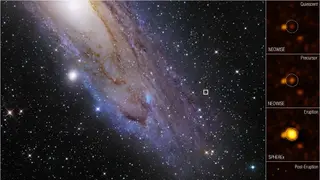
For the first time, astronomers have observed a luminous red nova (LRN) in real time, capturing the full evolution of AT 2025abao in the Andromeda Galaxy across multiple wavelengths. The event resulted from the merger of two stars within a common envelope, a process predicted by theory but never directly seen before. Data from the James Webb Space Telescope (JWST), ground-based observatories, and multiple space missions allowed researchers to reconstruct the precursor, eruption, and post-eruption phases of the merger.
In October 2025, astronomers observed the luminous red nova AT 2025abao, a stellar merger event in the Andromeda Galaxy, in real time for the first time. The system, nicknamed "Bao," underwent a dramatic brightening—increasing 100 times in r-band brightness over 25 days—peaking at a temperature of about 8,000 Kelvin before cooling to 3,000 Kelvin over the following 80 days. This eruption followed years of gradual brightening in optical light from 2018 to early 2025, followed by a continued rise in infrared emission. The James Webb Space Telescope (JWST) captured data just 47 days after the peak, marking the earliest follow-up of such an event ever recorded. The merger resulted from a main sequence star, slightly less massive than the Sun, spiraling into a common envelope surrounding a puffy supergiant companion. The system completed only seven orbits—about seven years—before merging, a remarkably short timescale compared to the thousands of orbits typical in common envelope evolution. This observation confirms long-standing theoretical models of common envelope evolution (CEE), where drag from the shared gas envelope drives orbital tightening, leading to either ejection of the envelope or a merger. The research, led by Viraj Karambelkar of Columbia University and published in Nature, provides the first direct evidence of the final inspiral and eruption phase of a CEE system.
The discovery builds on decades of theoretical work and indirect evidence, but direct observation of such events has been elusive due to their unpredictability and rarity. Prior to this, astronomers had only inferred CEE from binary star population statistics and post-merger remnants. The team’s ability to monitor Bao continuously since 2018 allowed them to detect the precursor phase, which was critical for identifying the event. The collaboration involved multiple observatories, including ground-based telescopes and space missions, with JWST playing a pivotal role in capturing the post-eruption phase in infrared. The researchers, including co-author Nadia Blagorodnova from the University of Barcelona, emphasize that the rapid rise—peaking within a week—challenged expectations that such outbursts would unfold over years. What remains unresolved is the precise mechanism of envelope ejection and the exact mass and composition of the progenitor stars. Future observations may reveal whether the merged remnant forms a compact binary or a single star, and whether similar events can be predicted with improved monitoring strategies.
The observation of AT 2025abao could influence how astronomers prioritize transient monitoring programs, potentially shifting resources toward long-term surveys of nearby galaxies like Andromeda. The ability to catch a stellar merger in real time may lead to new protocols for rapid-response telescope allocation, especially with instruments like JWST. While the immediate impact is scientific—validating decades of theory—longer-term effects may include improved models for binary star evolution, which underpin our understanding of supernovae, gravitational wave sources, and the chemical enrichment of galaxies. The event also highlights the value of sustained observational campaigns, suggesting that persistent monitoring of stable systems may yield unexpected breakthroughs. A comparable case is the 2011 discovery of a luminous red nova in M31 (Andromeda), which was observed after the fact; this new event marks a leap in timeliness and completeness of data. The success of JWST in capturing early post-eruption data may encourage similar efforts in future transient studies. What could follow is a new generation of real-time transient alerts, possibly integrated with AI-driven analysis, to identify and respond to such rare events more efficiently. However, the broader societal impact remains limited to the scientific community, as the findings do not yet translate into public policy, commercial applications, or widespread cultural narratives.