ESA's Hera Mission Captures High-Resolution Images of DART Impact Site on Dimorphos
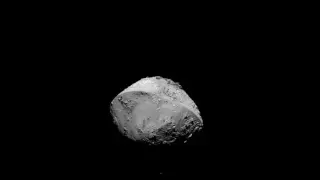
The European Space Agency's Hera probe has arrived at the binary asteroid system Didymos and captured detailed images of Dimorphos, the moonlet struck by NASA's DART mission four years prior. Using its Asteroid Framing Camera and HyperScout H spectrometer, Hera is analyzing surface features and composition to assess the impact's effects. The mission aims to validate planetary defense models by measuring changes in Dimorphos' orbit and structure after the high-speed collision.
In November 2026, the European Space Agency’s Hera mission arrived at the Didymos binary asteroid system, capturing its first high-resolution images of Dimorphos—the moonlet struck by NASA’s DART mission in September 2022. DART, launched in November 2021, impacted Dimorphos at over 22,000 km/h, altering its orbit around the larger asteroid Didymos by approximately 33 minutes, a result confirmed by ground-based telescopes over four years of observation. Hera’s arrival marks the first close-up follow-up to this historic planetary defense test. Equipped with the Asteroid Framing Camera, HyperScout H spectrometer, and the Thermal Infrared Imager (TIRI) provided by JAXA, Hera is now analyzing surface features, composition, and thermal properties. The TIRI instrument, described as giving the probe “Superman-like” heat vision, is particularly valuable for assessing the internal structure of Dimorphos by measuring how quickly surface materials cool—indicating whether the asteroid is solid or fragmented. Dimorphos, measuring 151 meters in diameter, remains partially obscured in visible light images due to its position in Didymos’s shadow, but appears clearly in infrared, glowing cool purple. Hera will later deploy two CubeSats, Juventus and Milan, to conduct in-situ studies, including surface touchdowns and ground-penetrating radar scans. The mission’s ultimate goal is to validate planetary defense models by precisely measuring how the impact altered Dimorphos’s orbit and structure. A major image release is scheduled for November 25 at the Berlin Museum of Natural History, signaling the start of deeper scientific analysis. What remains unknown is the full extent of the impact’s effects on the asteroid’s internal cohesion and whether the observed orbital change aligns with pre-mission simulations.
Hera’s findings could significantly influence how humanity prepares for potential asteroid threats, shaping future planetary defense strategies and international collaboration on space safety. The mission’s data may refine models used to predict how much force is needed to deflect hazardous asteroids, potentially affecting budgeting and planning for future missions. Governments and space agencies, particularly NASA and ESA, may use the results to justify increased investment in deflection technologies and early detection systems. The success of DART was a milestone, but its real-world effectiveness was uncertain without on-site verification—Hera fills that gap, potentially setting a precedent for post-impact monitoring in space missions. A comparable case is the 2005 Deep Impact mission, which sent a probe to collide with comet Tempel 1, providing valuable data on cometary composition but lacking long-term follow-up. Hera’s extended study of a controlled impact site may become a new benchmark for planetary defense missions. The public’s growing interest in space exploration, reflected in high readership for related articles, suggests that such missions may also bolster public support for space science funding. What to watch for next is whether Hera’s findings lead to standardized protocols for post-impact assessment, or if the data reveals unexpected complexities in asteroid response to kinetic impacts—could this shift how we design future deflection missions?