Hera Spacecraft Captures Infrared Images of Didymos-Dimorphos Asteroid System
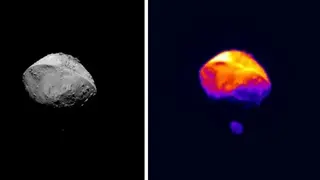
The European Space Agency’s Hera spacecraft has captured new images of the Didymos-Dimorphos asteroid pair from a distance of 17.7 miles, using multiple cameras and wavelengths. The Thermal Infrared Imager revealed temperature variations across the asteroids, with Dimorphos appearing cooler and Didymos showing a glowing ridge possibly formed by material migration due to its rapid spin. The data will help determine the composition and structure of the asteroids.
In October 2024, the European Space Agency (ESA) launched the Hera spacecraft on a mission to study the Didymos-Dimorphos binary asteroid system, a target of international interest following NASA’s DART mission in September 2022. From a distance of 17.7 miles (28.5 km), Hera captured new images using its Asteroid Framing Camera, HyperScout H, and Thermal Infrared Imager (TIRI), revealing detailed surface features and temperature variations. Dimorphos, measuring 495 feet (151 m) in diameter, appears mostly in shadow, while Didymos—780 meters wide—shows a prominent glowing ridge, possibly formed by material migration due to its rapid 2.2-hour rotation. The Thermal Infrared Imager detected cooler regions on Dimorphos and a hot, red-orange top half on Didymos, suggesting surface composition differences. HyperScout H captured 25 distinct wavelengths, enabling scientists to analyze reflectance patterns and infer material makeup. The mission’s primary goal is to assess Dimorphos’s mass, structure, and composition after the DART impact, which shortened its orbital period by 33 minutes and ejected debris across 10,000 km. Hera is currently in its early characterization phase, flying in rectangular orbits due to the asteroids’ weak gravity, and will soon transition to detailed characterization with closer flybys at about 12.5 miles (20 km). Two CubeSats will be deployed for in-situ observations, with a potential landing at mission’s end in June 2027, possibly extended.
The Hera mission could significantly advance planetary defense strategies by providing the first comprehensive post-impact assessment of a deflection experiment, offering real-world data on how asteroid structures respond to kinetic impact. This information may inform future mitigation efforts against potentially hazardous objects, potentially influencing international space policy and risk assessment models. The success of DART and the follow-up by Hera may strengthen collaboration between space agencies like NASA and ESA, setting a precedent for joint planetary defense missions. Comparable to the Apollo program’s role in advancing space technology and public engagement, this mission may inspire broader interest in space science and STEM education. The deployment of CubeSats and close-proximity operations could also spur innovation in small satellite technology and autonomous navigation systems. What remains to be seen is how the data will be integrated into global defense frameworks, whether new missions will be authorized based on these findings, and how quickly the scientific community can translate observations into actionable models. The long-term impact may depend on how effectively the results are communicated to policymakers and the public.