ESA's Hera Mission Arrives at Didymos System to Study DART Impact Effects
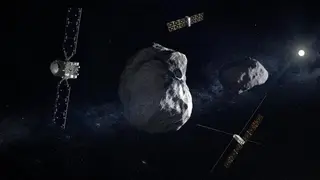
The European Space Agency's Hera spacecraft has reached the Didymos asteroid system, consisting of the larger Didymos and its smaller moonlet Dimorphos, to examine the damage caused by NASA's 2022 DART mission. Hera is now in its early characterization phase, collecting data on Dimorphos after its orbit was altered by a kinetic impact. The mission aims to validate impact models and improve planetary defense strategies against future asteroid threats.
In September 2022, NASA’s Double Asteroid Redirection Test (DART) spacecraft intentionally collided with Dimorphos, a 151-meter-wide moonlet orbiting the larger Didymos asteroid, which measures about 780 meters across. The impact occurred at a speed of 6.1 kilometers per second, delivering a kinetic punch that shortened Dimorphos’ orbital period around Didymos by approximately 33 minutes—exceeding pre-impact predictions and confirming the feasibility of asteroid deflection via impact. This marked the first real-world test of planetary defense strategies. Now, ESA’s Hera mission has arrived at the Didymos system, approximately 196.5 million kilometers from Earth, to conduct the first detailed post-impact survey. Hera, a spacecraft roughly the size of a small car, is currently in its early characterization phase, maintaining a stable rectangular flight pattern at distances of 25 to 30 kilometers from the binary system. This unique trajectory, enabled by the extremely weak gravity—200,000 times weaker than Earth’s—allows for safe, fuel-efficient navigation. The mission is led by the European Space Agency, with operations managed from ESA’s ESOC control center in Darmstadt, Germany. Scientists like mission scientist Michael Kueppers aim to validate or revise existing impact models by observing the physical changes to Dimorphos, including whether a large crater formed or if the impact caused widespread surface disruption. The full extent of the damage remains unknown, and Hera’s upcoming detailed characterization phase—expected next month—will bring it as close as 20 kilometers using complex bowtie-shaped trajectories.
Hera’s arrival marks a pivotal moment in planetary defense, transforming a theoretical concept into a measurable, data-driven science. The mission could reshape how space agencies assess and prepare for asteroid threats, potentially influencing future mission designs and international collaboration frameworks. While DART demonstrated that deflection is possible, Hera’s findings may clarify whether such impacts are more or less effective than models suggest—information critical for refining risk assessments and response protocols. If the impact caused more disruption than expected, it could imply that kinetic deflection is more effective than previously thought, possibly reducing the need for more complex or costly interventions. Conversely, if the response was more nuanced, it might highlight the need for better predictive tools. The mission also underscores the growing role of international cooperation in space safety, with NASA and ESA sharing data and objectives. A comparable precedent is the 2005 Deep Impact mission, which collided with comet Tempel 1 to study its composition—though that was a scientific curiosity, not a defense test. Hera’s success could catalyze a new era of proactive planetary defense, with implications for insurance, policy, and public awareness. What to watch for next: whether Hera’s data leads to updated models, informs future mission planning, or even triggers new international agreements on asteroid monitoring and response.