Trump Signals Willingness to Negotiate with New Democratic Majority Despite Veto Threats
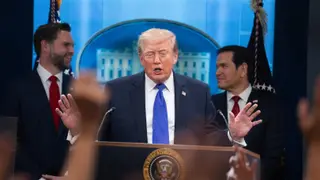
President Donald Trump said he believes he could achieve more with a Democratic-controlled Congress than he did under Republican leadership, citing potential bipartisan cooperation on health care and immigration. He warned Democrats he would use his veto power to force negotiations, predicting that House Minority Leader Hakeem Jeffries and Senate Majority Leader Charles E. Schumer would seek compromise due to their political savvy. However, Trump’s proposed agenda does not align with the Democratic priorities outlined by incoming leaders.
On November 20, 2026, President Donald Trump signaled a shift in tone toward the incoming Democratic majority in Congress, suggesting he might achieve more with bipartisan cooperation than under previous Republican control. Speaking in a 90-minute briefing at the White House, Trump claimed he had been contacted by “a lot of Democrats” about health care and immigration, though he did not name any specific leaders. He emphasized his willingness to use veto power as leverage, predicting that House Minority Leader Hakeem Jeffries and Senate Majority Leader Charles E. Schumer—both described as “smart” and “streetwise”—would eventually seek compromise. Trump highlighted two legislative proposals as potential bipartisan wins: the Senate-passed “Protect College Sports Act,” which would create federal rules for athlete name, image, and likeness deals, and the “Motion Picture, Television, and Entertainment Revitalization Act,” which would offer tax credits to boost domestic film production. He noted support from Senator Adam B. Schiff, a former critic during the Russia probe, and claimed broad bipartisan backing for both. However, these proposals face significant hurdles: the Protect Act is opposed by the Congressional Black Caucus, which sees it as tied to GOP redistricting efforts, and the entertainment bill faces resistance from House conservatives. Meanwhile, Democratic priorities—reversing Medicaid cuts, restoring ACA subsidies, ending the Iran conflict, and lowering consumer prices—do not align with Trump’s agenda. What remains unresolved is whether Trump’s veto threats will lead to real negotiations or merely stall progress, and whether Democratic leaders will engage despite ideological differences.
Trump’s pivot toward negotiation, even while threatening vetoes, could signal a strategic recalibration in the face of a Democratic majority, potentially easing legislative gridlock if both sides find common ground on specific issues like entertainment incentives or college sports regulation. However, the divergence in core priorities—especially on health care and foreign policy—suggests that major policy shifts remain unlikely. The potential impact on public trust is mixed: while bipartisan cooperation on non-ideological bills may bolster perceptions of governance, the use of vetoes as leverage could deepen partisan polarization. The entertainment and college sports bills may benefit industries and institutions reliant on federal support, but their passage hinges on overcoming internal party divisions, particularly within the Democratic Caucus. A comparable precedent is the 2009 health care reform debate, where initial resistance gave way to compromise after sustained negotiation, though that process was marked by intense conflict. What may unfold now is a test of whether veto power can be used not as a weapon but as a negotiation tool. The coming months will reveal whether Trump’s outreach is genuine or tactical, and whether Democratic leaders will prioritize incremental wins over ideological resistance.