New Image Reveals Betta Fish-Like Supernova Remnant in Centaurus Constellation
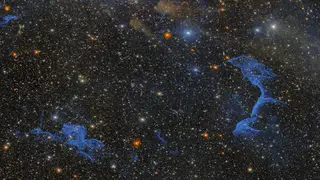
Astronomers using the Dark Energy Camera on the Víctor M. Blanco 4-meter telescope have captured a detailed image of SNR G295.5+09.7, a supernova remnant nicknamed the Betta Fish Nebula, located 6,800 light-years away in the southern constellation of Centaurus. The nebula, formed from the explosion of a massive star, features glowing blue filaments created by shockwaves colliding with interstellar gas, with a neutron star at its center. The image, the first of its kind from a professional observatory, reveals thousands of background stars and distant galaxies within the Carina-Sagittarius arm of the Milky Way.
Astronomers using the Dark Energy Camera (DECam) on the Víctor M. Blanco 4-meter telescope at Cerro Tololo Inter-American Observatory in Chile have captured the first professional image of the supernova remnant SNR G295.5+09.7, located 6,800 light-years away in the southern constellation of Centaurus. Nicknamed the Betta Fish Nebula for its distinctive blue, fin-like filaments, the remnant is the glowing aftermath of a massive star’s explosive death. The image reveals shockwaves from the supernova colliding with interstellar gas, producing luminous blue structures, while a neutron star—about 1.4 times the mass of the Sun compressed into a sphere just 20 kilometers wide—remains at the center. This neutron star, formed when the star’s core collapsed without becoming a black hole, is encircled by the expanding nebular shell. The image also captures thousands of background stars and distant galaxies within the Carina-Sagittarius arm of the Milky Way, highlighting the region’s rich stellar population.
The significance lies in the fact that this is the first time a professional observatory has imaged this specific remnant, despite its visual distinctiveness. Prior observations may have been limited to amateur or lower-resolution data, making this new image a milestone in observational astrophysics. The research team, affiliated with NSF’s NOIRLab and led by scientists including T.A. Rector and D. de Martin, aims to better understand the dynamics of supernova remnants and the conditions that lead to neutron star formation. The use of DECam, originally designed for dark energy studies, demonstrates the versatility of large-scale astronomical instruments. What remains unresolved is whether the Betta Fish Nebula’s structure offers clues to the original star’s mass or the asymmetry of the explosion. Future observations may focus on spectral analysis to determine composition and expansion velocity, potentially revealing more about the progenitor star and the interstellar medium’s role in shaping the remnant.
This image of the Betta Fish Nebula could inspire public interest in astrophysics by making complex cosmic phenomena visually accessible through a familiar, animal-like form. The nickname and striking appearance may boost engagement with science education, particularly among younger audiences, and could influence how space imagery is presented in media and museums. Institutions like NOIRLab may see increased support or outreach opportunities as the public connects with visually compelling discoveries. Comparable to the public fascination with the “Pillars of Creation” or the “Cosmic Reef” images from the Hubble Space Telescope, this discovery may become a cultural touchstone for space exploration. While the immediate impact is likely on public perception and science communication, longer-term effects could include greater funding for observational astronomy, especially for instruments with dual-purpose capabilities like DECam. The image also underscores the value of archival data and reanalysis—what was once overlooked may now be reinterpreted with new tools. Researchers may look for similar morphological patterns in other remnants, potentially leading to new classification systems. What to watch for is whether this visual appeal translates into sustained public interest in high-energy astrophysics or if it remains a fleeting viral moment. The broader scientific community may also explore how such imagery influences funding decisions and telescope scheduling priorities.