JWST Unravels Chemical Clues in Supernova Remnant Cas A
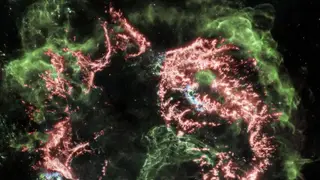
The James Webb Space Telescope has enabled astronomers to analyze the mid-infrared emissions from Cassiopeia A, a supernova remnant located 11,000 light-years away. By studying the chemical composition of the ejected material, researchers reconstructed details about the progenitor star’s internal structure, including prior shell mergers that mixed its elements. The Mid-Infrared Instrument (MIRI) and Medium-resolution Spectrometer (MRS) aboard JWST were critical in identifying molecular patterns within the expanding shockwave.
In November 2026, the James Webb Space Telescope (JWST) delivered groundbreaking insights into Cassiopeia A (Cas A), a supernova remnant located approximately 11,000 light-years from Earth and first observed by Earth-based astronomers around 1667. Using the Mid-Infrared Instrument (MIRI) and its Medium-resolution Spectrometer (MRS), researchers led by Tea Temim of Columbia University analyzed mid-infrared emissions from individual arcsecond-scale clumps within the remnant’s expanding ejecta. These clumps, each spanning up to the size of our Solar System, revealed distinct dust compositions that pointed to a previously unknown internal event in the progenitor star: a shell merger. Such mergers—where layers of oxygen- and carbon-burning material mixed before the explosion—altered the star’s internal structure and chemical distribution, leaving detectable imprints in the remnant’s ejecta. The study, published in The Astrophysical Journal Letters, builds on earlier Spitzer Space Telescope observations that identified regions of differing dust properties, which the JWST then resolved with unprecedented spatial and spectral precision. The research team, including scientists from UMBC and Purdue University, aims to reconstruct the life cycle of massive stars by decoding the chemical fingerprints in supernova remnants. What remains unresolved is whether shell mergers are common among massive stars or rare, and how frequently such events influence the distribution of metals in the interstellar medium. Future observations may explore other remnants to determine if similar patterns exist, potentially reshaping models of stellar evolution.
The findings from JWST’s study of Cas A could deepen public and scientific understanding of how elements essential to life—like carbon and oxygen—were distributed across the galaxy. By revealing the internal dynamics of a dying star through its remnant, the research underscores the role of massive stars in enriching the cosmos, a process vital to planetary formation and the emergence of life. This knowledge may influence how space agencies and educational institutions frame the importance of deep-space observation, potentially increasing public support for future missions. Institutions like NASA, ESA, and CSA, which funded and operated the JWST, may leverage such discoveries to justify continued investment in advanced telescopes. A comparable precedent is the Hubble Space Telescope’s role in transforming public perception of the universe through iconic images and scientific breakthroughs. While Hubble reshaped astronomy in the 1990s, JWST may be doing the same for astrophysics in the 2020s, particularly in infrared and molecular analysis. The societal impact may be indirect but significant: as the public becomes more aware of the cosmic origins of matter, interest in science education and space exploration could grow. What to watch for next is whether similar shell merger signatures are found in other supernova remnants, which could indicate a broader pattern in stellar evolution—potentially reshaping how we model star formation and galactic chemical enrichment.