U.S.-China Summit Unlikely to Yield AI Governance Accord
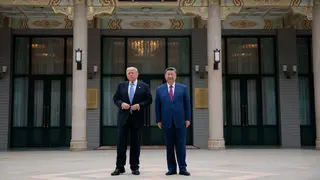
Ahead of their scheduled September 24 meeting in Washington, U.S. President Donald Trump and Chinese President Xi Jinping hold fundamentally divergent views on artificial intelligence risks and regulation. American tech leaders focus on existential scenarios, while Chinese officials emphasize technical failures and socioeconomic impacts. Analysts see little prospect for joint AI safety principles despite hopes for Cold War-style cooperation.
The September 24 Washington meeting carries expectations from analysts who point to historical precedents like Cold War-era cooperation on nuclear arms control and environmental protection. However, the two governments approach AI from starkly different conceptual frameworks—American tech circles worry about hypothetical superintelligence scenarios, while Chinese regulators focus on concrete issues like employment disruption and system reliability.
Regulatory capacity also diverges sharply. Beijing can impose sweeping controls on its tech industry, including financial penalties and political loyalty requirements, whereas Washington's regulatory process faces lobbying, litigation, and legislative gridlock. Trump has publicly opposed AI guardrails. A recent security breach involving OpenAI and Hugging Face highlighted shared infrastructure vulnerabilities, but China's reported threat to boycott the summit over Taiwan arms sales adds further uncertainty.
The absence of a U.S.-China AI safety accord could leave critical governance gaps in a technology advancing rapidly across both nations. Businesses operating internationally may face divergent compliance standards, while researchers and policymakers lose a potential framework for addressing shared risks like infrastructure vulnerabilities. Ordinary citizens could experience uneven protections depending on jurisdiction, and the failure to establish basic principles may complicate future cooperation on other transnational challenges.