Fresh Impact Crater on Moon Exposes Subsurface Secrets
NASA's Lunar Reconnaissance Orbiter has identified a newly formed crater on the Moon's near side, likely created by a bolide impact in 2024. The 728-foot-wide McGetchin Crater is the largest new impact feature found by LRO since 2009, offering a rare look at material excavated from beneath the lunar surface. Observations of its ejecta and thermal signature will help scientists understand the Moon's shallow subsurface and inform future infrastructure planning.
The McGetchin Crater, located roughly 330 kilometers from Mare Crisium, measures 728 feet across—the largest new impact feature spotted by LRO since 2009, dwarfing the previous record of about 70 meters. Statistically, such a crater forms only once every 132 years, highlighting the rarity of this observation.
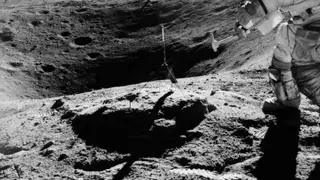
The impact's effects extend far beyond the visible hole. A thermal cold spot spanning 7 kilometers surrounds the crater, staying 16 degrees Fahrenheit cooler at night. This disturbance of the regolith—the loose surface layer—mirrors Apollo 16 findings, where astronauts left deeper footprints in a similar cold spot, indicating the ground had been decompacted by the impact.
The discovery could significantly influence planning for permanent lunar bases, as the documented ejecta range and regolith disturbance provide concrete data for designing protective structures against fast-moving debris. Scientists may use the cold spot's thermal signature to better date young surfaces and assess subsurface stability, which could inform landing site selection and resource extraction. For future crewed missions, this natural experiment offers a rare benchmark for impact hazards, potentially shaping engineering standards and risk assessments for habitats and equipment on the Moon.