Non-Abelian anyons demonstrate universal quantum computing operations
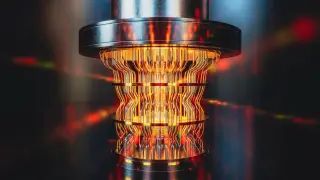
Researchers used 54 qubits on Quantinuum's H2 processor to perform a complete set of quantum operations with non-Abelian anyons. By combining braiding and fusion, they achieved a universal gate set, a first for this approach. This could offer a more efficient path to reliable quantum computers without costly error correction.
The research team created non-Abelian anyons by entangling 54 qubits on Quantinuum's H2 processor, producing collective states that mimic exotic particle behavior. Their work combined two operations—braiding, where anyons move around each other, and fusion—to achieve a complete universal gate set, something braiding alone could not accomplish.
This approach may bypass the need for "magic state" distillation, a resource-intensive purification process that consumes significant qubit capacity in standard error correction schemes. The findings suggest non-Abelian codes could provide fault-tolerant computation without that expensive overhead, potentially offering a more efficient route to reliable quantum machines.
If this approach matures, it could reduce the qubit overhead needed for error correction, potentially accelerating the timeline for practical quantum computers. Industries relying on complex simulations—pharmaceuticals, materials science, cryptography—may eventually benefit from more accessible quantum systems. However, widespread impact remains years away, and the technology must first prove scalable beyond laboratory demonstrations.