Milky Way’s First Microblazar Detected in Dust-Shrouded System
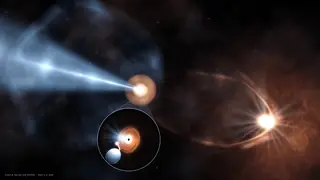
Astronomers have identified the first known microblazar in the Milky Way, a small-scale analog of active galactic nuclei that launch powerful plasma jets. The system lies about 12,000 light-years away and consists of a black hole and a star locked in orbit, with the black hole pulling material from its companion and expelling some toward Earth at roughly three-quarters the speed of light. Although the object was cataloged decades ago, dust had obscured it in optical observations until the new analysis.
The object is the first microblazar identified in our galaxy, a miniature counterpart to blazars, which are active galactic nuclei powered by supermassive black holes that emit fast plasma jets. It lies roughly 12,000 light-years away, where a black hole and a star orbit closely; the black hole strips matter from the star and sends part of it toward Earth at about 75% of light speed.
Although astronomers had cataloged the system decades earlier, dust made it essentially undetectable in ordinary optical images, so it was largely forgotten. The new study, led by Josep Martí and accepted by Astronomy & Astrophysics, may help researchers examine how such jets evolve, interact with interstellar material, and whether similar systems exist.
This discovery could broaden public and scientific interest in black hole systems within our galaxy, potentially influencing how astronomy stories are communicated and prioritized. Researchers may gain a new nearby laboratory for studying jet physics, while observatories could pursue multiwavelength follow-up. For society, the main effect may be cultural and educational: a clearer sense that extreme astrophysical processes occur closer to home, though practical daily impacts are unlikely in the near term.