Exoplanet Found Circling Its Red Dwarf in Reverse
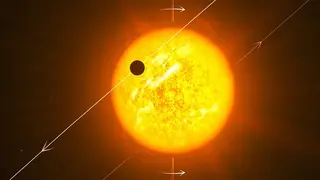
A research team led by Yann Carteret identified GJ 3090 b, a sub-Neptune roughly 2.2 times Earth's width and 4.5 times its mass, orbiting a cool red dwarf 73 light-years away every 2.9 days. Using the ESO 3.6-meter telescope, they watched five transits and detected the Rossiter-McLaughlin effect in the opposite pattern from a normal aligned system, showing the planet moves retrograde relative to its star. Its orbital obliquity is about 136 degrees, making it the first exoplanet found orbiting backward around a red dwarf and raising questions about planet formation models.
GJ 3090 b is a sub-Neptune measuring about 2.2 Earth radii and 4.5 Earth masses. It circles a cool red dwarf in Phoenix, 73 light-years away, completing an orbit in roughly 2.9 days. Researchers used ESO's 3.6-meter telescope in Chile to observe five transits.
The Rossiter-McLaughlin signal appeared reversed: the planet crossed the star's redshifted side before the blueshifted side. Its obliquity is near 136 degrees, indicating retrograde motion. Because no massive companion explains it, the team suggests a primordial disk flip, where later infalling material formed a second disk with opposite angular momentum.
This finding could affect astronomers and planetary-formation theorists by challenging assumptions about how red-dwarf planets form and migrate. It may spur follow-up observations of GJ 3090 b and similar systems, potentially refining models discussed in classrooms and public science coverage. Space enthusiasts and educators might gain another example of planetary-system diversity, though the direct impact on most people's daily lives is likely minimal.