Latin America Prioritizes Solar-Storage Integration and Grid Infrastructure in Major Project Cycle
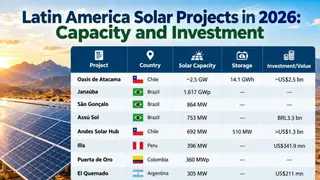
Latin America's utility-scale solar market is evolving beyond capacity-focused development toward comprehensive projects integrating photovoltaic generation, battery storage, transmission infrastructure, and industrial power purchase agreements. Brazil hosts several benchmark projects including Elera Renovaveis' 1.6 GW Janauba Solar Complex and ENGIE's 753 MW Assu Sol facility, both addressing grid curtailment challenges through advanced planning. Regional clean energy investment reached approximately $70 billion in 2025, with individual solar and solar-storage projects now involving investments ranging from hundreds of millions to over $2 billion.
Latin America's renewable energy sector is undergoing a fundamental transformation in how projects are structured and valued. Rather than pursuing isolated solar farms focused purely on capacity metrics, developers now recognize that successful large-scale projects require integrated planning across generation, storage, grid connectivity, and long-term electricity contracts. This shift reflects growing recognition that grid constraints—particularly curtailment issues that limit when solar facilities can operate—demand comprehensive solutions involving battery systems and transmission upgrades alongside photovoltaic installations.
The financial scale of these integrated projects has expanded substantially, with individual developments now requiring billions in capital investment. This represents a maturation of the regional market, where investor confidence in solar-plus-storage platforms is strong enough to support ventures of unprecedented scope across multiple countries including Brazil, Chile, and others throughout Latin America and the Caribbean.
This investment evolution could affect electricity consumers across Latin America by improving grid reliability and potentially moderating energy costs over time through better resource utilization. Policymakers and utilities may need to adapt regulatory frameworks to accommodate hybrid projects with complex operational requirements. The capital intensity of these ventures could influence which companies participate in regional energy development, potentially concentrating project ownership among larger investors capable of securing multi-billion-dollar financing while creating employment in manufacturing, construction, and technical services.