Africa's Solar Market Transitions to Gigawatt-Scale Projects with Battery Storage Integration
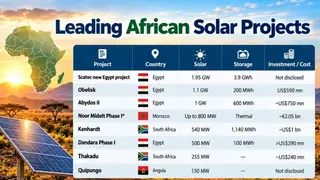
Africa installed a record 4.5 GW of solar capacity in 2025 with a 54 percent year-over-year increase, marking a shift toward larger projects combining photovoltaic generation with battery storage systems. Egypt has become the continent's solar investment hub, with Scatec completing its 1.1 GW Obelisk project featuring 200 MWh of battery storage and securing financing exceeding $590 million from development banks. A subsequent Egyptian project combining 1.95 GW of solar with 3.9 GWh of battery storage represents Africa's largest renewable investment to date, designed to provide round-the-clock baseload renewable electricity.
Africa's renewable energy market is fundamentally shifting its investment priorities. Rather than measuring success primarily by installed solar capacity, developers and financiers now prioritize projects that combine generation with substantial battery systems capable of storing and dispatching power according to grid demand. This structural change reflects growing recognition that solar's intermittency—its inability to generate power after sunset—limits its usefulness without storage integration.
Egypt has positioned itself as the continent's leading hub for this hybrid infrastructure model, attracting major international development financing. The concentration of gigawatt-scale projects with accompanying battery systems in Egypt suggests that continent-wide investment capital increasingly flows toward locations offering both technical readiness and long-term purchasing agreements, particularly when development banks can participate in financing packages.
These large hybrid projects could meaningfully affect Africa's electricity access patterns by enabling more reliable renewable baseload power, potentially reducing dependence on diesel generation and fossil fuels. Affected populations may experience improved grid stability and potentially lower energy costs over time. However, project success depends on factors including grid infrastructure capacity, maintenance capabilities, and sustained policy support. The concentration of investment in Egypt and South Africa may also create geographic disparities in renewable transition benefits across the continent.