Four-winged fossil from China provides new evidence on dinosaur flight origins
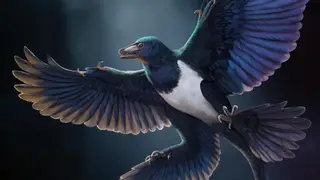
Scientists have identified a newly described feathered dinosaur species called Norellraptor barsboldi from Early Cretaceous deposits in China, which featured four wings and predatory adaptations. The specimen, only 21 inches long and just 3 years old at death, adds evidence that flight evolved independently multiple times across different dinosaur lineages. The discovery helps clarify the evolutionary relationship between non-avian dinosaurs and early birds.
The Norellraptor barsboldi specimen represents a particularly young individual, having only reached three years of age before fossilization in what is now northeastern China during the Early Cretaceous period. Its small stature and predatory anatomy suggest it occupied a specialized ecological niche, hunting small vertebrates rather than competing with larger dinosaurs. The four-winged structure, combined with curved claws and teeth, demonstrates adaptations for an active predatory lifestyle.
The research team's comparative analysis examined nearly two hundred anatomical features across different dinosaur lineages. Their findings suggest that while microraptors and early birds shared approximately 30 percent of evolutionary innovations—including feather development and skeletal modifications that supported flight—these changes accumulated in fundamentally different sequences and combinations within each group, supporting the hypothesis of convergent evolution rather than shared origin.
This discovery may influence how museums and educational institutions present dinosaur-to-bird evolution, potentially shifting public understanding of how complex traits develop across species. The findings could redirect paleontological research priorities toward studying convergent evolution mechanisms in extinct lineages. Academic communities studying vertebrate evolution may refine theoretical frameworks for understanding how similar flight-enabling structures arise independently, with implications for broader evolutionary biology and our comprehension of adaptive pathways in deep time.