Western Wind Turbine Makers Shift Competition Focus to Profitability and Service Revenue
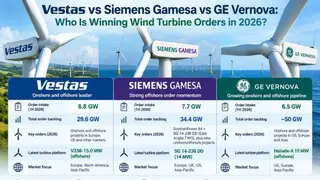
Major Western wind turbine manufacturers are competing less on raw megawatt volumes and increasingly on order quality, operational margins, and long-term service contracts. Vestas leads in publicly disclosed order momentum with 7.85 GW booked in the first half of 2026, while Siemens Gamesa prioritizes profitability restoration and GE Vernova emphasizes selective contracting strategies. High-value offshore projects, such as Vestas's 2.76 GW Vanguard projects in the UK, demonstrate how turbine sales create opportunities for decades of service revenue beyond initial equipment sales.
The competitive landscape among Western turbine manufacturers has fundamentally shifted away from a pure volume race. Rather than chasing maximum installed capacity, companies now emphasize operational profitability, execution reliability, and capturing long-term maintenance revenue streams. This reflects industry maturation as customers demand proven technology and manufacturers recognize that service contracts—spanning decades—generate substantially more lifetime value than one-time equipment sales.
Vestas demonstrates this strategy through diversified geographic ordering and high-value offshore contracts, while Siemens Gamesa focuses on stabilizing profitability from existing commitments despite possessing advanced large-turbine technology. GE Vernova's selective approach indicates that selective, quality-focused ordering may be preferable to aggressive volume pursuit, signaling a market transition toward sustainable, margin-conscious growth models.
This competitive realignment could affect energy project developers and utilities by raising barriers to entry for smaller manufacturers while potentially improving turbine reliability and long-term cost predictability. Grid operators may benefit from more dependable equipment paired with dedicated service networks. However, consolidation toward fewer dominant competitors might eventually reduce supplier choice and pricing pressure. Consumers could experience more stable renewable energy supply costs if operational reliability and maintenance consistency improve, though the emphasis on profitability may be reflected in project pricing.