Indian Wind Market Intensifies as Suzlon and Inox Wind Expand Beyond Utility-Scale Projects
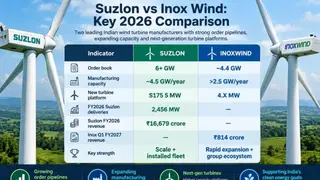
India's wind capacity reached 58.52 GW by August 2026, with 2.43 GW added in just five months as Suzlon Energy and Inox Wind compete for diverse customer segments beyond traditional utility auctions. Suzlon maintains a clear lead with an order book exceeding 6 GW compared to Inox Wind's 4.4 GW, though both manufacturers are increasingly targeting commercial-industrial customers and hybrid renewable projects. The competitive landscape is shifting from securing turbine orders to effectively converting backlog into installed capacity while improving energy generation efficiency and building recurring maintenance revenue.
India's wind energy sector is experiencing rapid growth, adding nearly 2.5 gigawatts of capacity in just five months of the fiscal year. This expansion reflects a fundamental shift in how wind power is being procured across the country. Beyond traditional government-led utility auctions, manufacturing companies, industrial facilities, and corporate entities seeking sustainability commitments are now driving substantial portions of new demand. This diversification means turbine manufacturers must serve multiple customer types with varying project scales and technical requirements.
The two leading domestic manufacturers are positioned differently within this evolving landscape. While Suzlon maintains a quantitative advantage in its project pipeline and order backlog, both competitors increasingly compete for contracts beyond their historical market segments. The strategic challenge for these firms is no longer simply securing orders but efficiently executing their existing backlogs while generating additional revenue through maintenance services and equipment upgrades over the lifetime of installed systems.
This competitive intensification between India's domestic wind manufacturers could strengthen the country's renewable energy infrastructure and potentially lower costs through market competition. Enhanced efficiency in converting orders to operational capacity may accelerate India's progress toward its renewable energy targets, benefiting energy security and emissions reduction goals. The expansion into commercial and industrial segments could help decentralize energy generation, though success depends on sustained execution and technological performance across dispersed project locations nationwide.