Chinese Turbine Manufacturers Lead in Scale but Struggle with Global Market Penetration
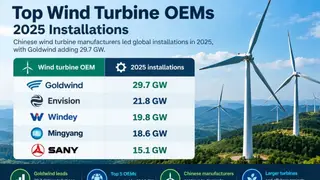
Chinese wind turbine makers Goldwind and Envision have captured the top positions in annual installation volumes, with Goldwind installing 29.7 GW and Envision 21.8 GW in 2025, while Vestas remains the most geographically diversified operator across 36 countries. The challenge for Chinese manufacturers is converting manufacturing scale and technological advancement into profitable international projects and lasting service contracts in markets outside China. Goldwind's expansion into Saudi Arabia and other international markets signals the next phase of competition, where establishing local manufacturing and securing long-term service revenue becomes as important as turbine shipments.
The wind turbine industry experienced dramatic growth in 2025, with global installations reaching 178 GW—a 40 percent increase. Chinese manufacturers now dominate production volumes, accounting for two-thirds of worldwide installations. However, this manufacturing superiority has not yet translated into comprehensive global market control, as these companies operate in far fewer countries than their Western counterparts.
The competitive landscape is shifting as Chinese manufacturers pursue deeper international engagement. Beyond simply exporting turbines, companies like Goldwind are establishing local production facilities and securing long-term service contracts that generate revenue throughout a turbine's operational lifetime. Access to international financing and the ability to provide comprehensive technical support across multiple decades have become critical differentiators in winning large-scale projects.
This market shift could affect energy transition timelines globally, as increased competition may accelerate turbine cost reductions and technological innovation across the industry. For developing nations seeking affordable wind capacity, Chinese manufacturers' expansion may provide more accessible options. However, the transition also raises questions about supply chain diversification, long-term service reliability, and technology standards in different regions. Investors and policymakers may recalibrate risk assessments as the industry's competitive structure evolves.