Fiber Networks Face Capacity Pressures as AI Data Centers and Streaming Drive International Bandwidth Demand
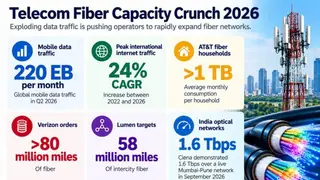
International internet bandwidth reached 2,259 terabits per second in 2026 with 23 percent year-over-year growth, shifting telecom fiber strategy from coverage expansion toward capacity optimization and cost reduction. Fixed-broadband consumption has multiplied dramatically, with AT&T Fiber households consuming over 1 terabyte monthly compared to 200 gigabytes in 2016, patterns expected to intensify further by 2030 from streaming, gaming, and artificial intelligence applications. Operators now prioritize adding fiber pairs, increasing wavelengths, upgrading optical equipment, and improving route diversity rather than simply expanding service footprints.
The dramatic shift in fiber investment priorities reflects fundamental changes in how networks are used. Where telecom planning once focused on geographic expansion—reaching new neighborhoods and towns—operators now concentrate on strengthening existing routes with additional fiber strands and advanced optical technology. This transition stems from consumption patterns that have intensified exponentially; residential users now transfer five times more data monthly than a decade ago, with projections suggesting another doubling by 2030.
The investment commitments underscore how intertwined residential broadband and AI infrastructure have become. Major carriers are simultaneously expanding fiber to homes while building capacity for hyperscale data centers serving artificial intelligence workloads. This dual-purpose infrastructure strategy represents a significant departure from previous network planning models that treated consumer broadband and enterprise connectivity as separate expansion priorities.
These capacity investments could reshape digital service availability and costs for consumers and businesses. Improved fiber infrastructure may enable faster broadband speeds and more reliable service in existing areas, potentially benefiting rural and underserved communities through secondary expansion. However, massive capital commitments concentrated on capacity optimization rather than new coverage might slow broadband access for remote regions. Network operators' focus on supporting AI infrastructure development could influence how computing resources are geographically distributed, affecting economic opportunities in different areas.