Analysis of Saturn's E Ring Uncovers Complex Chemistry of Enceladus' Ocean Plume
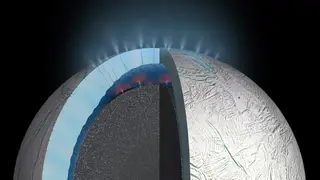
Examination of nearly 1,000 ice particles collected by NASA's Cassini spacecraft has revealed that salt grains ejected from Enceladus contain far greater chemical diversity than previously understood. Researchers identified at least five distinct chemical subtypes within salt-rich ice grains, including sodium chloride, sodium carbonate, phosphate salts, and hydroxide compounds. This detailed compositional analysis provides new insights into the subsurface ocean chemistry of Saturn's moon and suggests more complex processes govern how ocean material freezes and fragments when ejected into space.
Enceladus, a moon orbiting Saturn, harbors a subsurface ocean beneath its frozen crust. The moon periodically ejects icy material into space through cryovolcanic activity, creating Saturn's E ring. For over a decade, NASA's Cassini spacecraft collected and analyzed thousands of these ejected particles, measuring their chemical composition. Previous research identified three basic categories of ice grains, but the new investigation focused exclusively on the saltiest variety, discovering they contain five chemically distinct subtypes rather than a uniform composition.
The research team replicated Enceladus' conditions in laboratory experiments, freezing simulated ocean water at controlled temperatures to understand how different salts separate during the crystallization process. This two-stage formation model—slow freezing in subsurface vents followed by fragmentation into smaller particles—explains the chemical diversity observed by spacecraft instruments and provides a clearer picture of what chemistry exists within the hidden ocean.
This discovery may enhance the scientific foundation for future missions to Enceladus, potentially making it easier to detect signs of microbial life if present. The research could influence space agency priorities regarding investment in advanced ice-grain analysis technology for upcoming probes. Understanding ocean chemistry and habitability conditions may reshape how scientists evaluate the potential for extraterrestrial life, though any practical applications remain speculative and dependent on future mission success.