Understanding Wind Farm Economics: How Capacity Factor and Electricity Prices Shape Financial Returns
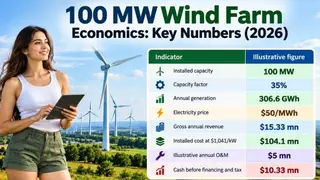
A 100 MW wind farm operating at a 35 percent capacity factor would generate approximately 306.6 GWh annually, producing roughly $15.33 million in gross revenue at a $50/MWh electricity price, though actual returns depend heavily on site-specific conditions and financing structures. Capacity factor variations significantly affect economics—improving from 30 percent to 40 percent increases annual output by 87.6 GWh without adding installed capacity—demonstrating why wind resource quality directly drives project profitability. Developers must account for capital expenditure, operations and maintenance costs, financing charges, curtailment, and turbine performance to determine actual cash flow, with electricity price assumptions ranging from $40 to $60/MWh producing annual revenues between $10.5 million and $21 million for the same asset.
Wind farm profitability hinges on two independent but equally critical variables: how much electricity the installation produces and what price developers receive for that power. A facility's capacity factor—the actual output versus theoretical maximum—varies dramatically based on local wind conditions and operational efficiency. Two wind farms with identical 100 MW capacity can differ by nearly 88 GWh in annual production simply by moving from 30 percent to 40 percent capacity factor, directly translating to millions in revenue differences without any increase in physical infrastructure.
Electricity pricing mechanisms create substantial financial leverage across projects. The choice between securing long-term power purchase agreements versus selling into volatile wholesale markets fundamentally reshapes project risk and financing feasibility. Even modest price fluctuations of $10 per megawatt-hour produce $3 million annual revenue swings, making contract terms and market conditions as economically consequential as the wind resource itself.
Wind farm economics directly influence renewable energy deployment rates and grid decarbonization timelines. Investors and project developers considering wind projects may use capacity factor and pricing analyses to assess viability, potentially affecting capital allocation across regions and technologies. Policy makers could reference such financial frameworks when designing renewable energy incentives or evaluating climate commitments. Understanding these economic drivers may help stakeholders identify which geographic markets and project structures support sustainable energy transitions.