The Offshore Wind Paradox: Long-Term Cost Declines Mask Current Financing and Construction Challenges
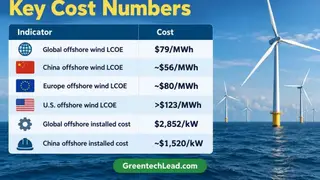
While offshore wind LCOE has plummeted 62 percent since 2010 to $79/MWh globally, projects in major markets face mounting pressure from higher construction costs, supply-chain constraints, and tightening financing conditions that are offsetting earlier efficiency gains. Regional economics diverge sharply, with China achieving approximately $56/MWh compared to $80/MWh in Europe and over $123/MWh in the United States, reflecting differences in CAPEX, financing availability, and supply-chain maturity. A representative 1 GW fixed-bottom offshore project requires roughly $5.44 billion in capital expenditure, while floating designs exceed $7.35 billion—costs where even modest inflation additions significantly impact project viability.
Offshore wind technology has achieved remarkable cost reductions since 2010, yet the industry confronts a paradoxical situation where these long-term gains are being undermined by immediate pressures. Construction inflation, limited access to affordable capital, and bottlenecks in supply chains—particularly specialized vessels and port facilities—are eroding project profitability even as per-unit generation costs continue their historical decline. The sector is fragmenting geographically, with mature markets like China demonstrating significantly lower economics than emerging offshore regions.
The shift toward larger turbines illustrates the complexity of scaling benefits. While deploying fewer machines per project reduces certain infrastructure needs, it simultaneously demands expanded port capacity and more capable installation equipment. These infrastructure requirements create cascading cost pressures that may offset the ostensible savings from reduced turbine quantities, making project feasibility increasingly dependent on regional capabilities and local supply-chain maturity.
The offshore wind paradox could shape renewable energy investment patterns substantially. Developers and policymakers in high-cost regions may face difficult trade-offs between long-term decarbonization goals and near-term project economics, potentially slowing deployment in markets like the United States and Europe. Conversely, financing pressures and CAPEX volatility may accelerate cost innovations and manufacturing consolidation, ultimately benefiting future projects. The widening regional divide may also influence where clean energy manufacturing and supply chains become concentrated globally.