Seoul-Hanoi Rare Earth Partnership, Regional Investment Push Shape Indo-Pacific Supply Chains
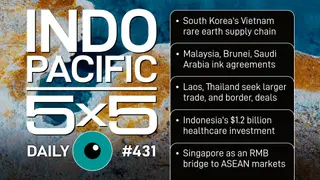
South Korea's LS Eco Energy is establishing a rare earth metal production facility in Vietnam with Australian supplier Lynas to create a non-Chinese supply chain for U.S. defense applications, with operations beginning in December 2026. Saudi Arabia's PIF-backed developer has signed strategic partnership agreements with Malaysia and Brunei, while Singapore positions itself as a bridge for Chinese yuan trading within ASEAN. Indonesia is channeling $1.2 billion toward healthcare infrastructure improvements as Thailand and Laos pursue bilateral trade and border cooperation agreements.
The Seoul-Hanoi rare earth initiative represents a coordinated effort to establish alternative processing infrastructure outside Chinese control. Lynas, Australia's only commercial rare earth producer operating independently of China, will supply raw materials to LS Eco Energy's Vietnamese facility, which aims to process 240 tons of samarium metal annually—sufficient feedstock for 700-1,000 tons of specialized permanent magnets used in defense applications. This supply chain reorganization responds directly to new U.S. Department of Defense regulations requiring non-Chinese sourcing beginning January 2027.
Simultaneously, regional economic activity extends beyond defense sectors. Saudi Arabia's sovereign wealth fund-backed developer is pursuing mixed-use development agreements in Malaysia and Brunei valued at approximately $14.3 billion combined, while Southeast Asian nations pursue bilateral trade and infrastructure investments. Indonesia's $1.2 billion healthcare commitment and Thailand-Laos trade initiatives ($4.39 billion in regional commerce) demonstrate broader economic repositioning across the Indo-Pacific.
These developments may reshape global supply chains by reducing dependency on single-source suppliers for critical defense materials, potentially affecting manufacturing timelines and costs for defense contractors worldwide. Regional economies could benefit through increased foreign investment, infrastructure development, and technology transfer partnerships. However, supply chain diversification may also create competitive pressures on existing producers and could influence geopolitical alignments as nations position themselves within emerging trade blocs and strategic partnerships across the Indo-Pacific.