Pristine Ice Layers Beneath Mars' North Pole Preserve Ancient Climate History
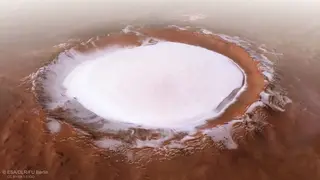
Analysis of Mars' north polar region reveals unexpectedly clean subsurface ice layers beneath the dusty exterior, offering an archive of the planet's climate fluctuations preserved like tree rings. Mars' unstable axial position, influenced only by two small moons, causes extreme oscillations that generate periodic ice ages covering roughly one-third of the planet. Dust coverage significantly affects ice behavior by altering the surface's reflectivity and warming rate, making accurate characterization essential for interpreting the climate record trapped within these frozen deposits.
Mars' climate history is fundamentally shaped by its orbital instability. Unlike Earth, which benefits from lunar stabilization, Mars experiences dramatic axial shifts caused by its two insignificant moons. These fluctuations trigger periodic ice ages that blanket roughly a third of the planet's surface. Scientists have long recognized that subsurface ice deposits function similarly to tree rings, encoding atmospheric conditions and dust patterns across millennia.
The challenge of accurately measuring ice composition has hampered climate research. Previous analysis methods, adapted from lunar soil studies, produced inconsistent results when tested against known conditions. By applying techniques developed for terrestrial snow and ice analysis, researchers discovered the north polar ice contains substantially less dust contamination than earlier estimates suggested, potentially refining our understanding of Martian climate cycles.
This research could advance our understanding of planetary climate systems and improve predictions about Mars' habitability for future exploration missions. More accurate ice characterization may guide where humans should land or establish research stations, as dust content affects water accessibility and resource extraction feasibility. Additionally, studying Mars' climate oscillations offers comparative insights into Earth's own climate stability and the role celestial mechanics play in long-term environmental change, potentially informing climate modeling on our own planet.