New Analysis Reveals Mars North Polar Ice Contains Significantly Less Dust Than Previously Thought
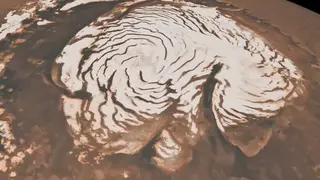
A recent study using spectroscopic instruments and comparative Earth-based research revised estimates of dust content in Mars' north polar ice cap from approximately 25 percent to only 3 percent by mass. Researchers discovered that the polar region has a multilayered structure with alternating ice and dust strata, which differs from previous models. The findings have implications for water extraction from the ice cap for future human missions and for understanding Mars' climate history.
Recent spectroscopic analysis of Mars' northern ice deposits has fundamentally challenged decades of scientific assumptions about their composition. Using data from multiple orbiting instruments and surface landers, researchers determined that the polar region exhibits a distinctly layered architecture, with alternating bands of frozen water and dust rather than a uniformly mixed substance. This structural discovery proved critical to revising downward the estimated dust concentration from one-quarter of the ice's total mass to merely one-twentieth.
The finding connects to broader Martian climate science, as the planet's unstable axial tilt—swinging dramatically over millennia—drives massive redistributions of ice and atmospheric dust. Understanding how dust becomes trapped or exposed within polar ice helps scientists reconstruct ancient climate cycles and the dramatic environmental shifts Mars experienced across geological time periods.
This research may influence planning for future human Mars missions, as accurate water-ice composition affects both extraction feasibility and yield calculations for life support systems. The cleaner ice composition could reduce technological requirements for water purification. Additionally, the improved understanding of Mars' climate history through ice-layer analysis may refine models predicting planetary habitability and atmospheric evolution, potentially shaping long-term strategies for scientific exploration and resource assessment.