Quantum vacuum fluctuations demonstrated to enhance superconductivity in ultrathin materials
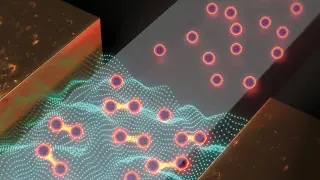
Researchers showed that quantum fluctuations present in supposedly empty space can strengthen superconductivity, increasing the transition temperature of ultrathin materials by up to 5.4 percent. The finding demonstrates that engineered vacuum environments can control quantum states in matter without direct physical contact. This opens new possibilities for manipulating exotic states of material using quantum effects previously thought to be merely theoretical.
Quantum mechanics reveals that true emptiness is impossible. The vacuum itself seethes with activity as particle-antiparticle pairs constantly materialize and vanish in billionths of a second, governed by fundamental uncertainty principles. This background noise has moved beyond pure theory—scientists have measured its effects through several well-documented phenomena spanning decades of research.
Building on earlier work manipulating these fluctuations with magnetic fields, the research team engineered a specialized cavity operating at terahertz frequencies to amplify the naturally faint quantum effects. By placing an ultrathin superconductor inside this redesigned electromagnetic environment, they demonstrated that the material's ability to conduct electricity without resistance improved measurably compared to identical samples tested outside the cavity.
If reproducible across different materials and conditions, this approach could reshape superconductor design without requiring higher physical temperatures or stronger magnets. Industries relying on superconductivity—from medical imaging to power transmission—might eventually benefit from enhanced performance in compact systems. However, practical applications remain distant; the enhancement occurred in laboratory conditions with specialized equipment, and significant engineering challenges would need resolution before any commercial deployment became feasible.