Helium Detection in Distant Exoplanet's Atmosphere May Reveal Clues About Habitability
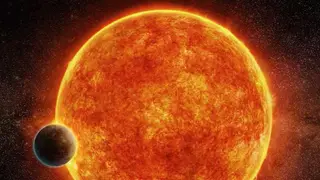
Astronomers observed helium gas escaping from the atmosphere of LHS 1140b, a rocky exoplanet located in its star's habitable zone, suggesting the presence of a long-lasting secondary atmosphere. A second observation failed to confirm the helium detection, making the initial finding tentative and requiring further investigation. Analyzing this exoplanet's atmospheric composition could advance scientists' understanding of how planetary atmospheres develop and help identify biosignatures on potentially habitable worlds.
LHS 1140b represents a significant target in exoplanet research because it combines two key characteristics: a rocky composition and an orbital position within its star's habitable zone, where temperatures might support liquid water. The planet orbits a red dwarf star considerably smaller and dimmer than our sun, located in the constellation Cetus. Scientists previously used the James Webb Space Telescope to eliminate the possibility of a hydrogen-dominant atmosphere surrounding this world.
The distinction between primary and secondary atmospheres is crucial to understanding planetary development. Primary atmospheres form alongside young planets but dissipate relatively quickly into space, while secondary atmospheres—such as Earth's, which has persisted for billions of years—remain stable over geological timescales. The tentative detection of helium suggests LHS 1140b may possess such a long-lived secondary atmosphere, though a follow-up observation failed to confirm this finding.
This discovery could influence how scientists prioritize exoplanet observations and refine methods for detecting atmospheric composition on distant worlds. If confirmed, understanding LHS 1140b's atmospheric chemistry may help researchers develop better techniques for identifying biosignatures—chemical markers of life—on potentially habitable planets. Such advances could reshape planetary habitability assessments and guide future space telescope missions, potentially affecting funding priorities and research directions in astrobiology and exoplanet science.