Unexpected X-ray behavior offers potential new signature for identifying neutron star collisions
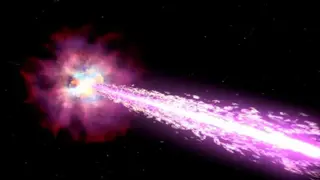
Researchers observed an unusual X-ray afterglow from a gamma-ray burst that may indicate a new method for detecting neutron star mergers. Unlike typical afterglows that gradually fade, the X-ray emission from event GRB 250704B showed rapid brightness and spectral changes, suggesting an active energy source persisting after the initial burst. This discovery could help astronomers identify and study these cataclysmic cosmic events more effectively.
Neutron star collisions represent extreme cosmic phenomena capable of forging heavy elements like gold and platinum. When two such objects collide, they typically generate a brief burst of gamma radiation followed by a gradually diminishing X-ray glow. The event GRB 250704B deviated from this pattern significantly. While its initial gamma-ray discharge lasted less than half a second, the subsequent X-ray activity persisted for roughly ten minutes and displayed unexpected fluctuations in intensity and spectral composition throughout this period.
Scientists propose that a magnetar—a neutron star possessing exceptional density, rapid rotation, and powerful magnetic fields—may have emerged from this collision. Such an object could theoretically sustain X-ray emission by continuously releasing its rotational energy over several minutes, explaining the atypical observations. The discovery highlights a previously overlooked detection signature that earlier research may have inadvertently missed due to instrumental limitations in existing gamma-ray observation systems.
This finding could refine astronomers' ability to catalog and investigate neutron star mergers throughout the observable universe. Enhanced detection methods may enable scientists to gather more comprehensive data about these events, potentially advancing understanding of heavy element formation and fundamental physics. The research could influence future telescope design and observation strategies, though practical applications remain limited to scientific inquiry rather than direct human benefit. The work demonstrates how unexpected celestial observations can reshape methodology in astrophysical research.