India's Fixed Broadband Sector Surges 30 Percent as Fiber and 5G Fixed Wireless Access Compete for Market Share
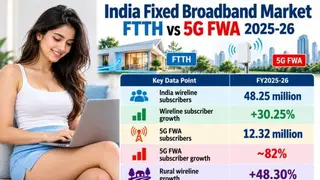
India's wireline subscriber base jumped 30 percent to 48.25 million in the fiscal year ending March 2026, driven by simultaneous expansion of fiber-to-the-home networks and 5G fixed wireless access technology. Rural wireline connections grew particularly rapidly at 48 percent, indicating substantial untapped opportunity in underserved areas where operators can deploy either technology to reach households and businesses. Meanwhile, 5G FWA subscribers more than doubled to 12.32 million in a single year, demonstrating how wireless technology is emerging as a competitive alternative to fiber infrastructure in India's broadband market.
India's broadband infrastructure is bifurcating into two competing delivery models, each with distinct advantages. Fiber-to-the-home remains the traditional choice for reliable, high-capacity service, while 5G fixed wireless access offers rapid deployment without requiring physical infrastructure installation. The data reveals that both technologies are expanding simultaneously rather than one replacing the other, suggesting operators view them as complementary solutions for different market segments and deployment scenarios.
Rural markets present a particularly compelling case for technology agnosticism. The near-equal split of 5G FWA subscriptions between urban and rural areas contrasts sharply with the historically urban-concentrated wireline base, indicating wireless technology may prove especially valuable in regions where fiber buildout faces geographic or economic constraints. Rural connection growth at nearly 48 percent outpacing urban expansion suggests previously underserved populations now have viable broadband options.
This market divergence could reshape India's digital inclusion trajectory by enabling faster broadband reach to underserved populations. Competition between fiber and wireless technologies may drive service quality improvements and pricing pressure, potentially benefiting consumers. However, the outcome depends on regulatory frameworks that ensure equitable investment across regions and sustainable competition. Operators' technology choices will significantly influence which communities gain reliable connectivity and at what cost, making infrastructure policy decisions increasingly consequential for bridging India's digital divide.