India's Telecom Operators Face Monetization Challenge as Data Traffic Outpaces Revenue Growth
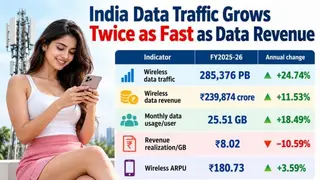
India's mobile data consumption surged 25 percent to 285,376 petabytes in fiscal 2026, but operators' revenue per gigabyte declined 11 percent, creating a significant profitability gap for carriers investing heavily in 5G and network infrastructure. The disconnect intensified as 5G traffic exploded 88 percent to represent 38 percent of total wireless data consumption, with 5G accounting for nearly 90 percent of incremental traffic growth despite generating only modest average revenue per user increases. This pattern highlights a critical challenge for Reliance Jio, Bharti Airtel, and other Indian operators: converting rapidly expanding network usage into proportional revenue gains.
India's telecom sector is navigating a structural economic mismatch. While subscribers added roughly 93 million new users and individual consumption patterns nearly doubled to over 25 GB monthly, operator earnings failed to scale accordingly. The revenue gap widened despite total data income climbing by approximately ₹25,000 crore, because that increase was distributed across vastly larger traffic volumes. This compression of per-gigabyte returns occurs precisely when carriers face substantial capital outlays for spectrum licenses, infrastructure deployment, and technology upgrades required to support expanding user bases and emerging applications.
The disparity intensifies with 5G's rapid adoption. Despite generating nearly nine-tenths of incremental traffic growth, 5G deployment has not yet reversed the decline in revenue realization per unit of data delivered. Operators face a timing challenge: the transition to next-generation networks requires immediate investment, but proportional revenue recovery remains uncertain and gradual.
Indian consumers benefit from abundant, affordable mobile connectivity as operators compete aggressively on pricing. However, sustained monetization challenges could constrain carriers' ability to fund continued network modernization, rural expansion, and service quality improvements. Telecom operators may seek alternative revenue models—enterprise solutions, edge computing, or value-added services—to offset data margin compression. How successfully they navigate this transition could determine whether India's network infrastructure keeps pace with growing demand and whether competition-driven affordability remains sustainable.