NASA's Roman Space Telescope begins its mission to unlock dark matter and dark energy mysteries
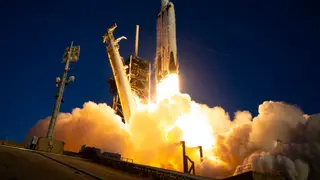
The Nancy Grace Roman Space Telescope, launched by NASA in August 2026, has begun observations and is expected to survey approximately 12 percent of the sky during its five-year mission—a dramatic increase from the 0.1 percent covered by Hubble over 35 years. The telescope's advanced 300-megapixel camera and broad field of view make it uniquely suited to study dark matter and dark energy, the mysterious components that comprise roughly 95 percent of the universe. Researchers hope Roman will provide crucial insights into the nature and behavior of these elusive cosmic phenomena.
The Nancy Grace Roman Space Telescope represents a significant shift in observational strategy for NASA. Rather than building a larger instrument or studying previously inaccessible wavelengths, Roman leverages an exceptionally wide field of view paired with a 300-megapixel camera to survey the cosmos with unprecedented efficiency. In just ten months, the telescope will accumulate observational data equivalent to what Hubble gathered across its entire 35-year operational life.
The telescope's primary scientific focus centers on two cosmic mysteries that dominate modern physics. Dark matter and dark energy collectively constitute approximately 95 percent of the universe's composition, yet scientists understand remarkably little about their fundamental nature or mechanisms. Roman's ability to observe 12 percent of the sky during its five-year mission should generate vast datasets enabling researchers to study these phenomena across cosmic distances and timescales, potentially revealing patterns invisible to previous instruments.
Roman's discoveries could reshape fundamental physics by providing empirical data about dark matter and dark energy, phenomena that currently remain theoretical. Breakthrough findings might influence cosmological models taught in universities, advance theoretical physics research globally, and potentially guide future technology development. However, the telescope's impact will likely remain concentrated within scientific communities initially, with broader public understanding depending on how discoveries are communicated. Any insights gained could take years to validate and integrate into established scientific frameworks.