Battery Storage Leadership Splits Three Ways as BESS Market Doubles
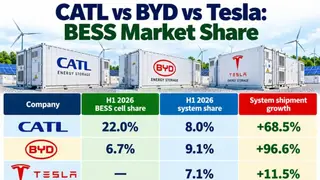
The global battery energy storage market exceeded 490 GWh in cell shipments during the first half of 2026, with CATL dominating battery cell production at 22 percent market share while BYD emerged as the leader in complete system shipments at 9.1 percent. Tesla ranks fourth in system shipments at 7.1 percent, differentiating itself through software optimization and its Megapack platform. The divergence between cell and system leaders reveals how the market is evolving from pure manufacturing scale competition into broader contests over system integration, project execution, and lifetime value delivery.
The battery storage sector is experiencing explosive growth, with worldwide cell shipments nearly doubling to over 490 GWh during the first half of 2026. This expansion reflects accelerating global demand for grid-scale energy storage solutions needed to support renewable power integration and grid stability. The market is simultaneously becoming more complex, with manufacturers competing across different value-chain positions rather than solely on production capacity.
Three companies have carved distinct competitive niches within this rapidly expanding landscape. One leads in raw battery cell manufacturing through sheer production scale and capacity investment. Another has leveraged its integrated capabilities to dominate finished system assembly and delivery to end customers. The third has differentiated through specialized platform design and software capabilities. This fragmentation suggests the market rewards diverse strategies rather than a single dominant approach.
The divergence in leadership positions could reshape investment and partnership decisions across the energy sector. Grid operators and renewable developers may benefit from increased competition spurring innovation in system efficiency and project execution. However, supply-chain concentration at the cell level—where one manufacturer controls over one-fifth of production—may create bottlenecks or pricing pressure that could affect energy storage deployment costs and timelines for utilities and energy companies transitioning toward renewable infrastructure.