Three BESS Platforms Pursue Different Paths to Dominate Energy Storage
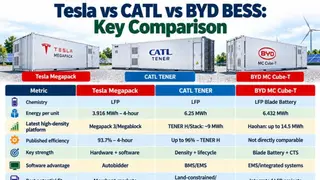
Tesla Megapack, CATL TENER, and BYD MC Cube are pursuing distinct strategies in the utility-scale battery storage market, with Tesla emphasizing software-driven revenue optimization through its Autobidder platform, CATL focusing on energy density and long-duration efficiency, and BYD leveraging its vertically integrated manufacturing and cell-to-system architecture. Project economics rather than hardware specifications alone are increasingly determining competitiveness, with factors including installation costs, warranties, grid connections, and revenue models significantly affecting lifetime returns. No single manufacturer has demonstrated universal cost or performance superiority across all project types, particularly as projects scale into multi-gigawatt-hour installations.
The battery storage market is experiencing a fundamental shift in how competitiveness is measured. Rather than focusing solely on technical specifications, project developers and utilities must now evaluate complete systems including installation expenses, service agreements, performance guarantees, and revenue-generation capabilities. This holistic assessment becomes especially critical as installations grow substantially larger, where even modest differences in efficiency or cost per unit can translate into millions of dollars in lifetime returns.
Manufacturing capacity and supply chains are also shaping competitive positioning. Tesla's planned Houston facility expansion, CATL's documented shipment volumes exceeding 100 GWh annually, and BYD's integrated production approach all reflect strategies to meet surging global demand. However, actual project deployment across diverse geographies and grid conditions will ultimately reveal which platforms deliver superior outcomes across varying scenarios.
The outcome of this competition could meaningfully influence renewable energy deployment economics worldwide. Utilities and developers selecting between these platforms affect capital efficiency, project timelines, and grid stability improvements. Lower-cost, higher-reliability storage solutions may accelerate renewable adoption by improving returns on investment, while different manufacturer strategies could shape which regions attract battery projects based on local grid needs and land constraints.