Understanding Battery Storage Economics: Profit Drivers, Operating Costs and Cash Returns
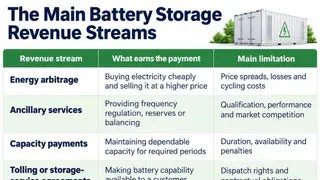
Battery energy storage projects generate revenue through electricity arbitrage—charging at low prices and selling at higher rates—while also receiving payments for capacity and balancing services. Profitability depends critically on the gap between charging and selling prices, with operating expenses, battery degradation, and financing costs significantly reducing investor returns. A worked example of a 100 MW/400 MWh facility shows how substantial gross revenues can yield modest net cash available to investors when all economic factors are considered.
Battery storage facilities operate on narrow profit margins despite generating substantial gross revenues. The difference between what operators pay to charge batteries and what they receive when selling electricity—their primary income source—gets substantially reduced by maintenance costs, insurance, software licensing, and trading fees. Additionally, batteries degrade over time as they cycle, which represents a real economic cost that must be accounted for separately from annual operating expenses.
The economics of any particular project vary dramatically based on local electricity price conditions. Markets with large price swings between peak and off-peak hours create better arbitrage opportunities, while stable pricing environments compress margins significantly. Auxiliary income from capacity payments and grid-balancing services can supplement electricity trading revenue, though these services may restrict when and how operators can use their batteries for primary profit-making activities.
Battery storage profitability analysis could influence investment decisions in renewable energy infrastructure, potentially affecting how rapidly storage capacity expands alongside wind and solar generation. Investors and policymakers may use clearer economic frameworks to evaluate whether storage projects deserve support through subsidies or grid service pricing reforms. Understanding the gap between headline revenues and actual investor returns could shape realistic expectations about storage's role in grid stability and climate goals.