Large Battery Storage Projects Cost $125 Million as Economics Vary by Duration and Configuration
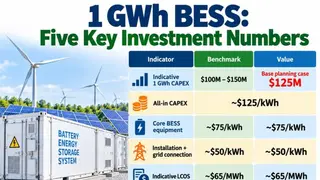
A 1 gigawatt-hour utility-scale battery storage system typically requires $100 million to $150 million in upfront capital investment, with approximately $125 per kilowatt-hour representing a useful benchmark for large, long-duration projects. Core equipment costs account for roughly $75 per kilowatt-hour while installation and grid connection add approximately $50 per kilowatt-hour, though actual project costs vary significantly based on discharge duration, power rating, grid interconnection complexity, and engineering requirements. The declining cost trajectory of battery storage is reshaping renewable energy economics, with levelized costs of storage estimated around $65 per megawatt-hour for large long-duration installations.
Battery storage systems serving the grid require far more infrastructure than just the cells themselves. A complete installation encompasses protective enclosures, power conversion equipment, management systems, cooling apparatus, fire suppression, electrical distribution components, structural work, engineering services, and interconnection infrastructure. This comprehensive scope means that attractive battery cell prices alone do not guarantee affordable projects—builders must account for all these ancillary systems when calculating true investment requirements.
Location decisions significantly influence project viability. A battery positioned near existing electrical infrastructure or paired with an adjacent solar or wind facility enjoys substantial cost advantages compared to installations requiring new substations or grid reinforcements. This economic reality is driving industry trends toward co-locating storage with renewable generators, creating integrated systems that reduce overall development expenses and potentially accelerate clean energy deployment.
Declining battery storage costs may accelerate renewable energy adoption by making grid stability more affordable to maintain. Developers and utilities could find it increasingly economical to pair storage with wind and solar farms, potentially reducing reliance on fossil fuel plants for load balancing. However, grid connection complexity and project-specific factors mean cost reductions may unevenly benefit different regions, potentially favoring areas with existing infrastructure while creating barriers in remote or underserved locations.