Hubble Telescope Detects Evidence of Planet Formation in Stellar Remnant System
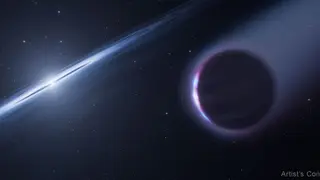
The Hubble Space Telescope has revealed evidence that planets can form around white dwarfs, suggesting planetary system development continues long after a star's death. Researcher Jamie Williams identified an unusual abundance of niobium in the white dwarf HS 0209+0832, indicating this element was synthesized late in the star's existence rather than at its birth. This discovery challenges conventional understanding of stellar evolution and suggests that what was previously thought of as the final chapter of a star's life may actually be the beginning of a new phase of planetary development.
The discovery centers on chemical signatures detected in archival Hubble observations from 1999. Researchers identified an unusually high concentration of niobium in the white dwarf's atmosphere—an element that typically forms only under extreme conditions during a star's final moments. The presence of this late-stage material suggests it was expelled into surrounding space rather than having originated at the star's formation, pointing to a mechanism for planet building in stellar remnants.
The suspected planet itself was confirmed through separate NASA observations tracking periodic dimming patterns. The Jupiter-sized world orbits remarkably close to its white dwarf host, completing an orbit every 4.4 days at a distance far nearer than Mercury's position relative to our Sun. This configuration emerged from the same material ejected during the star's death, challenging long-held assumptions about when planetary systems develop.
This finding may reshape astrophysical models of stellar evolution and planetary system formation timelines. Scientists studying exoplanet demographics could refine their understanding of where and when worlds develop, potentially accounting for a previously unrecognized population of planets around stellar remnants. For the broader public, the discovery underscores how stellar "death" may represent not an ending but a transition—suggesting the universe's capacity for creation extends further than previously understood.