Displaced Supermassive Black Holes Reveal Secrets About Cosmic History
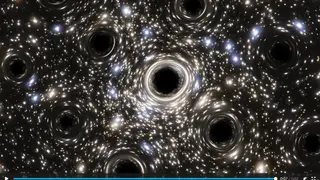
Researchers at Yale and the University of North Texas used advanced cosmological simulations to study black holes that travel freely through space rather than anchoring themselves to galaxy centers. The study suggests these wandering black holes originated as supermassive black holes displaced during galactic mergers billions of years ago. Understanding these displaced objects could provide insights into black hole formation and the evolution of their host galaxies.
The research employed ASTRID, a sophisticated computational model that simulates galactic systems across more than 12 billion years of cosmic history. Unlike previous approaches, ASTRID does not preset black holes at galaxy centers but instead calculates how gravitational dynamics naturally position them—enabling researchers to identify which objects remain anchored versus which drift through space as free-moving entities.
The findings suggest that low-mass galaxies are particularly prone to ejecting their central black holes during merger events, since their weaker gravitational fields cannot easily recapture displaced objects. Additionally, the simulations indicate that ancient "seed" black holes leave detectable traces in low-mass galaxies even after billions of years and multiple mergers, potentially offering astronomers a way to reconstruct early universe conditions and black hole formation mechanisms.
This research may influence how astronomers search for and catalog black holes across the universe, potentially revising current population estimates. If wandering black holes are more common than previously thought, it could reshape models of galactic evolution and merger dynamics. For the broader scientific community, the work may accelerate development of detection methods for these isolated objects and deepen understanding of fundamental physics governing the universe's largest structures and their formation history.